
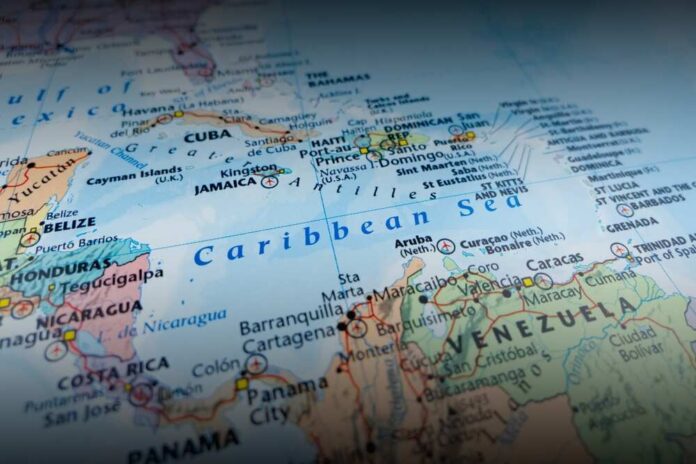
The U.S. military is now sinking suspected cartel-linked boats with lethal strikes in the Caribbean—and the government still hasn’t publicly shown proof those vessels were carrying drugs.
Story Snapshot
- SOUTHCOM confirmed kinetic strike on a suspected narco-trafficking vessel in the Caribbean that killed four alleged cartel-linked operatives.
- The strike is part of Operation Southern Spear, a campaign that began in September 2025 and expanded into the eastern Pacific in October 2025.
- Reporting across multiple outlets puts the campaign death toll at at least 181 people since early September 2025, with no U.S. military casualties reported.
- Officials say the strategy is meant to disrupt maritime smuggling routes, but public reporting notes a key gap: evidence of drug cargo has not been released.
What happened in the March 25 strike—and why it matters
U.S. Southern Command carried out a lethal “kinetic strike” against a vessel described as a suspected drug-trafficking craft moving along known smuggling routes in the Caribbean. SOUTHCOM said four alleged narco-terrorists were killed and that the operation was directed by Gen. Francis L. Donovan through Joint Task Force Southern Spear. Officials also reported no U.S. military casualties, underscoring how standoff capabilities are shaping this campaign.
The broader significance is that this is not a one-off interdiction; it reflects a sustained shift toward using military power to impose what SOUTHCOM has described as “total systemic friction” on cartel maritime logistics. President Trump has framed the cartel fight as an armed conflict and has defended the strikes as necessary to curb the drug flow and prevent overdoses. For voters who have watched fentanyl devastate communities, the escalation signals urgency rather than symbolism.
Operation Southern Spear: a growing campaign across two oceans
Operation Southern Spear began on September 2, 2025 in the Caribbean Sea and expanded into the eastern Pacific by October 2025, according to official and media reporting. The March 25 strike follows earlier actions, including a January 23, 2026 strike in the eastern Pacific that reportedly killed two people and injured one. The campaign has now included more than 45 strikes since September 2025, indicating a tempo more typical of sustained counter-network operations than traditional law-enforcement interdictions.
Multiple reports also describe additional weekend strikes in the Caribbean that killed three people per incident, contributing to a cumulative death toll that news outlets put at at least 181 people since early September 2025 across the Caribbean and the eastern Pacific. That scale is politically consequential. It places border security, cartel violence, and overdose deaths into a single national-security narrative—one that’s likely to intensify arguments in Congress over executive authority, oversight, and the long-term scope of military involvement.
The unresolved question: suspicion, intelligence, and public proof
The central tension in the reporting is straightforward: the vessels are repeatedly described as “suspected” trafficking boats, yet outlets also note that the military has not provided evidence that any of the struck vessels were carrying drugs. That gap matters for two reasons. First, it complicates public accountability in a democracy, especially when lethal force is used. Second, it creates an opening for critics to argue that intelligence judgments are being shielded from scrutiny.
Supporters of the policy will point to common-sense realities: cartels depend on maritime corridors, and waiting to “confirm cargo” can mean letting high-value shipments or operators disappear. Skeptics will counter that lethal action demands a higher public standard than a typical interdiction, because mistakes would be irreversible and could inflame regional tensions. What is clear is that the government has released strike footage but not the underlying targeting criteria or cargo verification methods.
Domestic politics: a familiar split, plus a shared distrust of institutions
In Washington, the political lines are predictable even with Republicans controlling Congress: Democrats are positioned to press for hearings, legal limits, and human-rights assurances, while the administration emphasizes security outcomes and deterrence. But the more interesting undercurrent is bipartisan distrust of federal institutions. Many Americans, left and right, suspect that agencies disclose only what supports their case. In this story, the missing public evidence becomes the pressure point that feeds that broader skepticism.
For conservatives frustrated by years of lax enforcement and ideological distractions, the campaign looks like a hard pivot toward sovereignty and public safety—using U.S. power to disrupt supply lines before drugs hit American streets. For liberals worried about concentrated power, it looks like another example of government expanding force with limited transparency. The facts available support both reactions: the operations are real and extensive, but key documentation remains undisclosed, leaving Americans to debate trust as much as tactics.
Sources:
Alleged narco-terrorists killed as US forces strike suspected drug-trafficking vessel in Caribbean
US military strike on suspected drug boat kills 3 in the Caribbean; Southern Command
US military strike on suspected drug boat kills 3 in the Caribbean; Southern Command (ABC3340)
US military strike on suspected drug boat kills 3 in the Caribbean; Southern Command (FOX23 Maine)
US military strike on suspected drug boat kills 3 in the Caribbean; Southern Command (WCTI12)
US military strikes suspected drug vessel in Caribbean