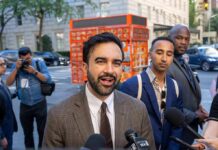
A Democrat mayor who tried to defund and micromanage his police force is now blaming his own handpicked chief for a scandal that started on his watch.
Story Snapshot
- Minneapolis Mayor Jacob Frey announced Police Chief Brian O’Hara’s resignation after an internal probe into alleged misconduct and interference with investigators.
- An outside law firm did not substantiate the original sexual-relationship allegation but did find that O’Hara deleted a city employee’s contact from his work phone during the probe.
- Frey’s written reprimand accuses O’Hara of “knowingly and intentionally” hiding potential evidence, calling it a major breach of public trust.
- The episode exposes ongoing leadership chaos in a city that once flirted with defunding police and still struggles to keep streets safe.
Mayor Frey Forces Out His Own Police Chief Amid Investigation Turmoil
Minneapolis Mayor Jacob Frey announced the resignation of his police chief, Brian O’Hara, following an internal investigation into claims that O’Hara interfered with a misconduct probe involving alleged “sexual intimate relationships” with city employees.[1][3] According to Frey and a written reprimand, the independent investigation concluded that O’Hara deleted a city employee’s contact card from his city-issued phone while the matter was under review.[1][3] Frey labeled the move interference that “risked the integrity of the investigation” and broke public trust.[1][3]
Local coverage reports that an outside law firm hired by the city examined the conduct allegations and the chief’s behavior during the probe.[1] Those reports indicate the firm did not find enough evidence to substantiate the original sexual-misconduct claim, narrowing the confirmed wrongdoing to interference with the process rather than the underlying relationship accusation.[1] That distinction allowed Frey to emphasize process integrity while avoiding saying the original personal allegations were proven.[1][3]
Evidence Deletion, Gag-Order Concerns, and a Written Reprimand
Mayor Frey’s written reprimand, described in multiple reports, asserts that O’Hara “knowingly and intentionally” deleted a city employee’s contact from his work phone “in an attempt to shield that evidence” from investigators.[3] Investigators also concluded that O’Hara discussed the ongoing investigation with at least one city employee despite instructions not to communicate about the probe.[1] Frey argued these actions showed a serious lapse in judgment by the city’s top law-enforcement officer and justified demanding O’Hara’s resignation.[1][3]
Coverage of the internal report makes clear that the city treated interference with the investigation as a standalone offense, separate from whether any relationship policy was violated.[1][3] In public-administration discipline cases, process violations like record deletion and talking about an active probe are often considered disqualifying on their own, especially for leaders who oversee transparency and accountability.[1] For residents already skeptical of Minneapolis leadership after years of anti-police rhetoric, the notion of a chief deleting information on his phone during a sensitive probe only deepens concerns about judgment at the highest levels.[1]
Unproven Allegations, Disputed Intent, and What Resignation Really Means
Reports stress that the independent law firm did not substantiate the original sexual-relationship allegation that triggered the investigation, even as it faulted O’Hara for interfering with the review.[1][3] That outcome supports the chief’s contention that resignation does not mean he admitted to the initial misconduct claim, but rather faced discipline over his handling of the process.[1] Public descriptions of the report carefully separate the unproven personal allegation from the later interference finding, underscoring that difference for readers.[1][3]
The city’s decision to focus discipline on the deletion of the contact and conversations about the probe reflects a broader reality: once an investigation begins, officials are often judged more harshly for tampering with the process than for accusations that cannot be proven.[1] For conservatives who value equal justice under the law, this case raises questions about selective outrage—why Democratic city leaders tolerate years of soft-on-crime policies, yet only show urgency when bureaucratic process is threatened inside City Hall.[1][3]
What This Says About Minneapolis Leadership and Public Safety Culture
O’Hara, who had served as Minneapolis police chief since late 2022, is only the latest top official to exit as the city struggles with crime, staffing shortages, and political fallout from its earlier push to weaken policing. After years of “reimagine public safety” experiments and attempts to sideline the police department, Minneapolis still faces public-safety challenges while cycling through high-level leadership.[3] Frey quickly installed Assistant Police Chief Katie Blackwell as acting chief, signaling another reset in a department already under intense scrutiny.[1]
For many Americans watching from the outside, the episode reinforces a pattern in progressive-run cities: politicians lean on police leaders when convenient, then move to discard them when scandals or pressure mount.[1][3] Minneapolis residents are left with yet another transition at the top, while gun rights, neighborhood safety, and basic law and order remain urgent concerns that City Hall’s political drama does not solve.[1] The next chief will inherit not just a department, but a culture shaped by years of mistrust and mixed messages from its own leaders.[3]
Sources:
[1] Web – Jacob Frey’s Little Sidekick Police Chief Dealt Career Blow After …
[3] Web – Brian O’Hara resigns as Minneapolis police chief after report shows …