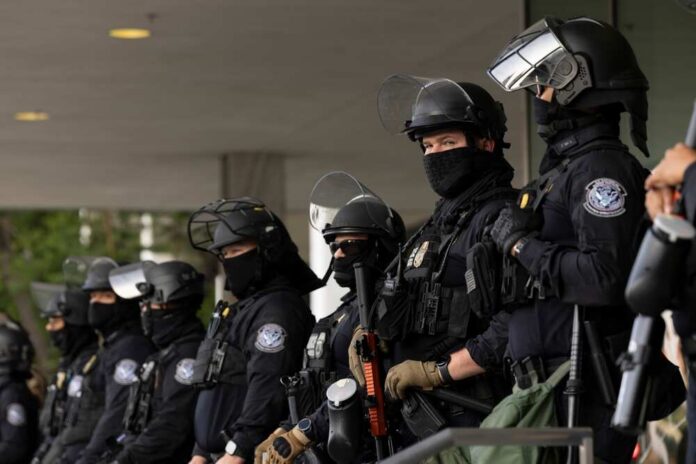
When a violent ambush with guns and explosives gets softened into a “protest,” it confirms many Americans’ fear that powerful media gatekeepers are rewriting reality to protect their own side.
Story Snapshot
- A Washington Post reporter described the Prairieland ICE detention center attack as a “protest,” despite convictions for terrorism and attempted murder.
- Federal prosecutors say an Antifa cell carried out a planned ambush using fireworks, rifles, and explosives against an immigration detention facility.
- A police officer was shot in the neck, and eight defendants received a combined 450 years in prison for the riot and terror-related crimes.[1][6]
- The clash over the word “protest” highlights how media framing can hide violence, deepen distrust, and fuel the sense that elites manipulate the truth.[6][7]
What Actually Happened At The Prairieland ICE Facility
On the night of July 4, 2025, a group linked by prosecutors to a North Texas Antifa cell attacked the Prairieland Immigration and Customs Enforcement detention center in Alvarado, Texas.[1][6] Prosecutors say members used fireworks, gunfire, and vandalism to draw officers out of the facility before opening fire.[6] One local police officer responding to the attack was shot through the neck but survived.[1][6] The group also damaged vehicles, a guard kiosk, and security equipment during the assault.[6]
According to the United States Department of Justice, the defendants did not simply join a rally that spun out of control. Officials say they carried out advance scouting, discussed bringing firearms, and arrived in dark clothing and face coverings, some with body armor and military-style medical kits.[1] Evidence presented at trial included planning messages, talk of freeing detainees, and coordination about gear, including rifles.[1][4] These details led federal prosecutors to call the event a planned ambush, not a spontaneous march that got heated.[5]
From “Riot” And “Terrorism” In Court To “Protest” In The News
A federal jury in Fort Worth convicted nine defendants of serious crimes tied to the attack, including rioting with intent to commit violence, using weapons and explosives, and providing material support to terrorists.[3] One man, identified as Benjamin Hanil Song, was found guilty of attempted murder of officers and employees of the United States after shooting the Alvarado police officer.[1][6] Sentences ranged from 30 to 100 years, adding up to about 450 years of prison time for eight of the attackers.[1][6][9]
Federal officials stressed that these actions were “a far cry from some peaceful protest.” Yet a Washington Post reporter later described the Prairieland incident as an “ICE protest” and suggested it was a demonstration that turned violent.[1][7] That softer description mirrors some defense claims that the event was meant as a “noise demonstration” to support detainees, with fireworks used to be heard inside the facility.[6] Supporters say a few people broke off and escalated, while most came intending only to protest immigration detention.[6]
Why The Word “Protest” Matters To People On Both Sides
Many conservatives see this kind of media framing as proof that major outlets protect left-wing violence by blurring the line between protest and attack. They point to Prairieland and other incidents where Antifa supporters, or anti‑ICE activists, used weapons or called for violence, yet coverage downplayed the threat.[4][5] When a planned ambush with rifles and explosives is labeled a protest, it feels like the press is running cover for allies instead of telling hard truths that might upset their audience.[1]
Many liberals, meanwhile, worry about real abuses by Immigration and Customs Enforcement, including harsh conditions and aggressive tactics that have sparked protests and hunger strikes at other detention centers.[12][15][19][20] They know peaceful protests have been met with force and smear campaigns, and they fear any demonstration can be painted as “terrorism” to silence dissent.[15][19] For them, calling Prairieland only a terrorist ambush, without context, seems to ignore long‑running anger about immigration enforcement and the government’s heavy hand.[3][13]
Media, Government, And The Growing Trust Gap
The Prairieland case sits inside a bigger pattern: supporters frame events outside immigration facilities as civil resistance, while authorities and many outlets highlight the most violent actions and call them riots or terrorism.[1][6][7][11][17] At Prairieland, that conflict over words reached an extreme. Courts and the United States Department of Justice used terms like “terrorist acts,” “planned ambush,” and “material support to terrorists,” backed by trials and long sentences.[3][6] Yet some national coverage reduced the event to “ICE protest,” smoothing out the violence and planning.[1][7]
For Americans who already feel that the federal government and big media are run by unaccountable elites, Prairieland is another warning sign. People on the right see armed Antifa militants nearly killing an officer, then watch a major newspaper frame it as protest. People on the left see harsh immigration enforcement, death and injury in detention facilities, and long prison terms that may reflect politics as much as justice.[5][13][18][20] Both sides walk away thinking the system bends truth to protect itself.
What This Says About Power, Accountability, And Language
Prairieland shows how one word can hide or reveal reality. Calling a planned, armed attack a “protest” makes it sound almost normal, especially in a country used to daily demonstrations. Calling it “terrorism” raises hard questions about how organized political violence is growing inside our borders, and why some groups feel justified using guns and explosives against government targets.[6][7] The public deserves clear language, especially when officers are shot and hundreds of years of prison time are at stake.
It also shows why many Americans now doubt both official statements and media reports. When government agencies like Immigration and Customs Enforcement face real criticism for overreach, and extremist groups answer with violent attacks, citizens need honest reporting on both problems.[13][18][19] Downplaying violence or ignoring abuse only feeds the sense that a small class of powerful players—the “deep state” to some, “elites” to others—gets to decide which facts matter and which can be brushed off as just another “protest.”
Sources:
[1] Web – WaPo Reporter Calls Armed Antifa Attack on ICE Facility — With Officer …
[3] Web – Antifa Cell Members Convicted in Prairieland ICE Detention Center …
[4] Web – Jury finds defendants guilty of terrorism-related charges in attack on …
[5] YouTube – Texts reveal details in Prairieland ICE facility attack
[6] YouTube – Officials provide updates on Fourth of July “targeted attack” on ICE …
[7] Web – On July 4, 11 individuals set off fireworks in front of the …
[9] Web – Prairieland ICE detention center shooting trial: Here’s what we’ve …
[11] YouTube – Verdict reached in high‑profile Prairieland ICE attack trial
[12] Web – The third week of testimony began on Monday in the trial for nine …
[13] Web – Court Documents – Support the Prairieland Defendants
[15] Web – Detainees at Texas ICE facility protest living conditions – PBS
[17] YouTube – ICE shootings spark outrage, protests across the country …
[18] Web – Hundreds at Delaney Hall Join Detained People Across Country in …
[19] YouTube – Protesters clash with ICE outside New Jersey detention facility
[20] Web – Violence erupts at New Jersey ICE detention center protests – WGME