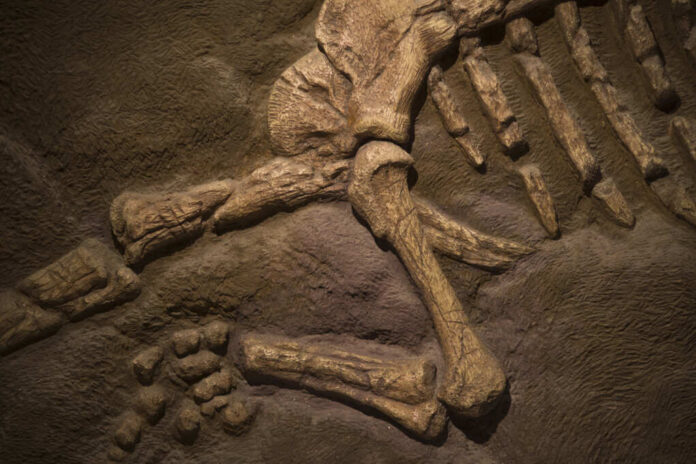
A 125-million-year-old “spiny dragon” fossil is forcing scientists to admit dinosaur skin was far stranger—and more engineered—than the tidy textbook story many Americans grew up with.
Story Snapshot
- Researchers identified a new dinosaur species, Haolong dongi, from Early Cretaceous deposits in northeastern China.
- The juvenile specimen preserves skin at cellular-level detail, including hollow, cylindrical spikes never documented in any dinosaur before.
- The spikes appear to be keratin-based structures with a porous core, suggesting specialized biology rather than ordinary scales.
- Scientists propose defense as the leading function, while thermoregulation and sensing the environment remain possible.
A new species, and a rare look at dinosaur “hardware”
Scientists formally described Haolong dongi in a February 6, 2026, peer-reviewed paper in Nature Ecology & Evolution, after analyzing a remarkably preserved juvenile fossil from northeastern China. The animal belongs to iguanodontians, a major plant-eating dinosaur group known for beaked mouths and strong hind legs. What makes this specimen different is not just a new name on the family tree, but preserved skin detail that lets researchers study anatomy down to microscopic structure.
Researchers report that the fossil includes extensive integument—skin and body covering—preserved with unusual fidelity, to the point that individual skin cells can be examined. That kind of preservation is rare in paleontology and allows scientists to move beyond guessing from bones alone. The discovery also shows why careful documentation matters: the team’s international collaboration combined museum work, imaging, and histology to pull hard information from tissue that is ordinarily lost to time.
Hollow spikes no one had seen before in a dinosaur
The headline feature is a field of hollow, porcupine-like spikes: cylindrical structures embedded among scales, with sizes ranging from a few millimeters to nearly two inches. Reporting describes two kinds of scales plus a dense mix of small and large spines, indicating a complex “mosaic” body covering rather than a single uniform texture. Researchers say these spikes are composed of a highly cornified outer layer over a multi-layered epidermis, consistent with keratin-based construction.
Analyses described in coverage indicate each spike contains a porous dermal pulp at its core, and cellular preservation extends to keratinocytes with nuclei visible. That matters because it moves the discussion from surface appearance to biological architecture: hollow structures, layered tissue, and internal pulp imply living functionality, not random ornamentation. Scientists also emphasize these spikes represent an independent evolutionary solution, distinct from protofeathers known in some dinosaurs and distinct from spines seen in modern lizards.
What the spikes were for: defense leads, but proof is limited
Researchers place defense at the top of the list of likely functions, comparing the deterrent effect to porcupine quills. That hypothesis fits common-sense biology: a plant-eater with prominent spines gains a survival advantage if predators think twice before biting. The team also raises thermoregulation and sensory perception as possible roles, since structures that increase surface area can influence heat exchange and could help detect movement or environmental changes.
Those functional ideas remain provisional because the evidence base is narrow: current conclusions come from a single individual, and it was juvenile. The skeleton’s unfused vertebrae indicate the animal was still growing, leaving a major unanswered question—did adults keep the spikes, or were they a young-stage feature? Researchers say that question cannot be answered without additional specimens, especially adult individuals, and the team’s own reporting treats that limitation as a central caution.
Why this matters: complex design in nature, and a reminder to stay humble
For Americans tired of being lectured that “the science is settled” on everything under the sun, this discovery is a healthy reminder that real science is often a process of correction. Iguanodontians have been studied for roughly two centuries, yet this specimen still managed to overturn assumptions about what their skin could look like. Researchers describe the find as evidence that dinosaur body coverings were more complex and varied than previously understood.
125 million-year-old dinosaur with never before seen hollow spikes discovered in China https://t.co/GSwvVgWbd4
— Zicutake USA Comment (@Zicutake) February 18, 2026
The methodological lesson is equally important: modern imaging and high-resolution analysis are expanding what can be learned from fossils, especially soft tissues once thought unrecoverable. If future discoveries confirm similar structures in other species, paleontologists may need to revise parts of ornithischian evolution and rethink how common defensive or heat-related adaptations were. For now, the strongest conclusion is straightforward and well-supported: Haolong dongi preserves a type of hollow, cutaneous spike that researchers say has not been documented in any dinosaur before.
Sources:
https://greekreporter.com/2026/02/17/spiny-dragon-dinosaur-fossil-china/
https://www.sciencedaily.com/releases/2026/02/260217005734.htm
https://phys.org/news/2026-02-dinosaur-spikes-unprecedented-properties-china.html
https://www.vice.com/en/article/new-spiny-dragon-dinosaur-species-identified-with-125-million-year-old-skin/
https://www.sci.news/paleontology/haolong-dongi-14545.html