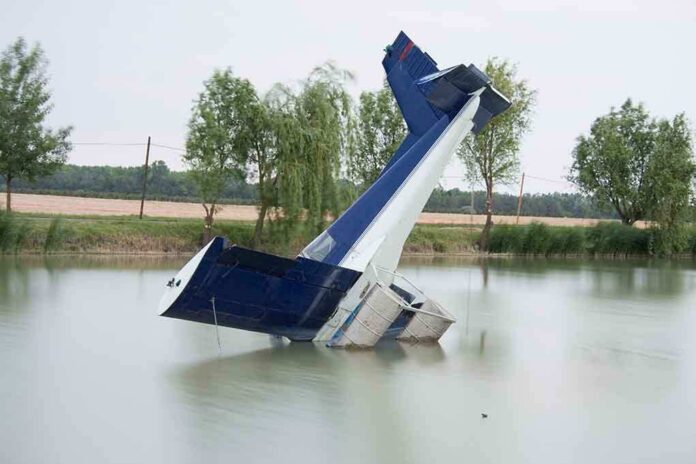
A small campaign flight lost engine power on final approach, forcing Wisconsin Rep. Tom Tiffany and his pilot to ditch into Lake Wausau and swim to safety.
Story Highlights
- Officials and dispatch audio confirm an emergency water landing and two survivors.
- Tiffany says the pilot warned, “We are going down,” before the lake landing.
- Rescuers pulled both men from the water; injuries required stitches but were not life-threatening.
- Federal agencies opened an inquiry to determine why the plane lost power.
Emergency Landing After Campaign Stop
On a Saturday evening in Wausau, a single-engine Beechcraft Bonanza lost engine power on final approach and landed in Lake Wausau with Rep. Tom Tiffany and pilot Leonard Boltz aboard. Dispatch audio captured rescuers saying there were two people in the water and that they were pulling them out. Local officials reported the rescue soon after 9 p.m., with both men surviving the water landing and swim to shore.
News reports identified the aircraft as a four-seat Beechcraft K35 and said only two people were on board. Tiffany told reporters the pilot warned him, “We are going down. Pull your seatbelt tight,” as they prepared for impact. Tiffany said both men exited the sinking aircraft and swam toward shore before first responders reached them by boat and brought them to safety.
Injuries, Rescue, and Agency Response
Medical staff treated Tiffany for a cut above his right eye that required 12 stitches. Doctors also gave him a computed tomography scan, which showed no concussion, according to local reporting. The pilot received four stitches. The Wausau Fire Department, Marathon County Sheriff’s Office, and local police responded, while the Federal Aviation Administration and the National Transportation Safety Board were notified to assess the event and possible next steps.
Reporters said the Beechcraft carried two occupants and lost power during final approach to the nearby airport. The pilot’s quick action to land on the lake limited the impact forces and kept the airplane upright long enough for both men to get out. Officials emphasized that a federal review would evaluate the circumstances of the power loss and document the sequence from approach to water contact.
What We Know and What Comes Next
Published accounts agree on the main facts: power loss on approach, a controlled water landing, a short time in the water, and a swift rescue with non-life-threatening injuries. Tiffany’s description of the pilot’s warning and their swim to shore matches the dispatch audio and local reporting that tracked the rescue timeline that evening. These aligned details provide a reliable picture of the emergency and its outcome for both the congressman and the pilot.
Tom Tiffany tearfully recounts making an emergency water landing in Lake Wausau Saturday night https://t.co/A3Sq29Flb5
— WBAY-TV 2 (@WBAY) September 14, 2026
The cause of the engine power loss has not been set. The National Transportation Safety Board explains that preliminary aviation reports usually post in about a month, and a full probable-cause report can take one to two years, depending on the case. That timeline helps explain why technical answers often trail the human story in early coverage of aviation incidents involving public figures.
Why This Resonates Beyond One Flight
A small plane in trouble near an American town is a reminder of what works and what fails. Here, training, local responders, and ordinary courage mattered most. People across the political spectrum see a system that often feels distant and unaccountable. But in moments like this, community responders showed speed and care. The federal review now must match that standard by explaining what failed and how to prevent it, without delay or spin.
Sources:
wausaupilotandreview.com, fox6now.com, facebook.com