
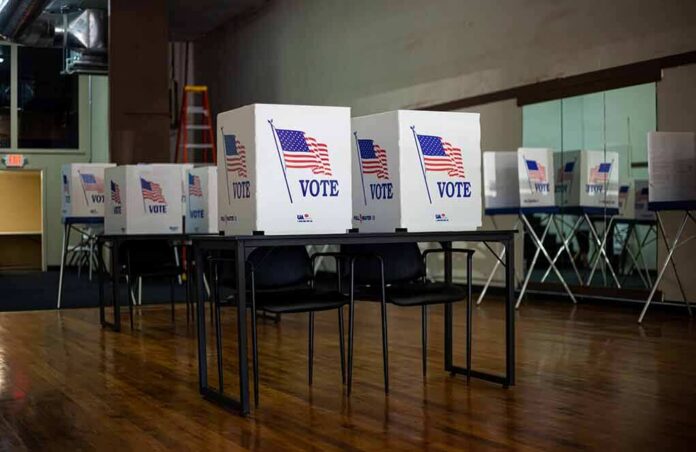
The Supreme Court’s stay lets New Hampshire block student IDs at the polls this November, sharpening a late-hour fight over who gets to prove identity and how.
Story Snapshot
- The Court stayed a lower-court order, allowing New Hampshire to exclude student IDs for the November election.
- HB 323 removed student IDs from the list of photo IDs that qualify to get a ballot, while a fallback process still exists.
- The state cited election-stability concerns close to Election Day; critics warned the switch would confuse voters.
- The ruling addresses timing and enforcement now, not the final legality of the ban.
What the Supreme Court’s Order Actually Did
The Supreme Court granted New Hampshire’s request to pause a lower-court ruling and restore limits on student IDs for the November election. The justices did not decide if the ban is constitutional. They ruled on timing and enforcement while the appeal continues. This means student IDs will not count as qualifying ID to get a ballot, and officials will follow the state’s guidance during voting this fall. The final outcome will come later, after full appeals.
New Hampshire argued that changing rules weeks before Election Day would disrupt training and confuse voters. The state leaned on the Court’s caution about late changes to election rules. The record shows competing guidance from the Secretary of State and a federal judge. The Supreme Court’s stay keeps the state’s stricter rule in place for now, while the appeals court reviews the case in full.
How HB 323 Changed Identification at the Polls
House Bill 323 removed student identification cards from the list of documents that qualify as valid photo ID to obtain a ballot. A voter who lacks a qualifying ID can still use a fallback process to prove identity by other means. The dispute grew after the Secretary of State told local officials not to consider student IDs even as supporting proof under that fallback. A federal judge said the law allowed some consideration as evidence, but that order is now on hold.
The Secretary of State’s office pointed students to other documents. The office listed driver’s licenses from any state, passports, or military IDs as accepted options, and said proof of residency could include mail such as a utility bill or a bank statement. The guidance aimed to give students a path, even without a state driver’s license. Critics said those documents are not as easy to get as a campus ID and could still leave gaps for some voters.
Why Timing and Messaging Became the Battlefield
Judge Joseph Laplante’s ruling on October 2 told officials they could consider student IDs as part of the fallback process. The state said that forced a last-minute shift in training and signs. The Supreme Court’s stay removed that shift. Voting-rights advocates countered that taking away a familiar document at the last second would itself mislead students. Both sides claimed they were trying to reduce confusion, but neither side presented hard data on how much confusion would result.
Advocates for students stressed that schools have used student IDs for years to help people register or obtain a ballot. They argued the state offered no evidence that student IDs caused fraud. They said the new rule falls heaviest on younger voters who often do not have in-state licenses. The lawsuit calls the measure age discrimination and an unnecessary barrier to eligible voters who already struggle with busy schedules and travel limits.
What This Means for November—and What It Does Not
For this election, voters in New Hampshire cannot use a student ID as a qualifying photo ID to receive a ballot. Voters without a qualifying ID may still use the fallback process, but the precise use of student IDs in that process remains limited under the state’s guidance while the stay is in place. The Supreme Court’s order is about immediate administration, not a final judgment on constitutional questions or the meaning of the fallback law.
Supreme Court lets New Hampshire enforce student ID voting ban pic.twitter.com/YCquRLqOfG
— NEK News (@NEKNews01) October 23, 2026
For readers worried about trust in the system, here is the bottom line. The state says it is tightening credentials to protect elections and reduce last-minute changes. Advocates say the rule change blocks a simple, common ID that many young voters rely on and that there is no proof it stops fraud. The high court’s emergency action keeps the stricter rule now, but the core debate—security versus access—remains unresolved in court and in the country.
Sources:
cbsnews.com, nhd.uscourts.gov, scotusblog.com, indepthnh.org, courthousenews.com, cnn.com, nbcboston.com