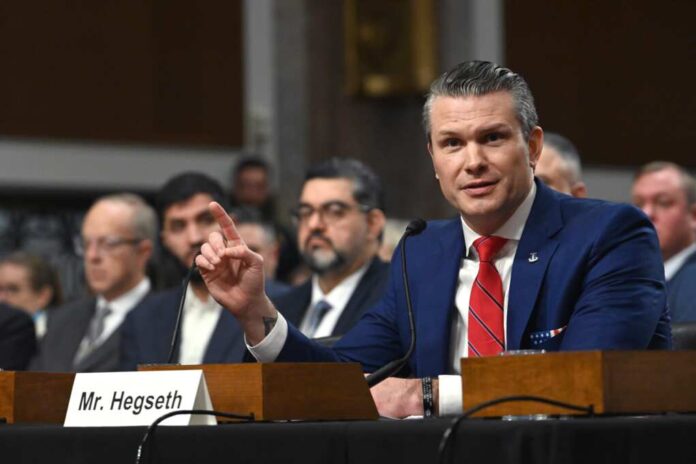
Republican senators are openly challenging Trump’s own defense chief over a secret “double‑tap” missile video, exposing a high‑stakes fight over transparency, war powers, and the people’s right to know what is done in their name.
Story Snapshot
- GOP senators are pressing Defense Secretary Pete Hegseth to release or declassify a Caribbean “double‑tap” strike video he insists must stay top secret.
- The clash exposes an unusual split inside the Republican Party over transparency, congressional oversight, and war‑powers limits in Trump’s counter‑drug campaign.
- Lawmakers from both parties are using the $901 billion defense bill to threaten part of Hegseth’s budget unless Congress gets full footage and authorizing orders.
- The dispute raises deeper questions about secret wars, Obama‑style targeting rules, and whether the Pentagon is hiding behind classification to dodge accountability.
GOP Senators Confront Secrecy Around Caribbean “Double‑Tap” Strike
On September 2, U.S. forces launched the first publicly acknowledged strike of President Trump’s new Caribbean counter‑drug campaign, hitting a suspected cocaine‑smuggling boat in international waters near Venezuela. The initial missile destroyed most of the vessel, but a second “double‑tap” shot killed the last two survivors in the water or on the wreck. That second strike, and the Pentagon’s refusal to release the full, unedited video, turned what began as a strong law‑and‑order operation into a flashpoint over secrecy.
In the weeks after the attack, U.S. Southern Command and Trump officials posted edited clips of other successful boat strikes on social media to showcase the campaign’s results against narco‑terrorist networks. Yet when it came to the September 2 mission, Defense Secretary Pete Hegseth drew a hard line, labeling the full footage “top secret” and off‑limits to the public. That selective openness—promoting highlights while hiding the most controversial tape—sparked bipartisan suspicion on Capitol Hill.
Trump’s Counter‑Drug Campaign Meets Old Obama‑Era Playbook
The Caribbean operations themselves fit squarely with Trump’s promise to crush cartels and stop the poison flowing into American communities, especially after years of open‑border chaos and fentanyl flooding U.S. streets. The administration has framed the mission as dismantling narco‑terrorist infrastructure near socialist Venezuela, a regime already under heavy sanctions. But lawmakers say the internal legal process behind these strikes looks uncomfortably similar to Obama’s drone‑war model: lawyers vet targets, interagency panels review, and classified memos justify lethal force far from declared battlefields.
For many conservatives, that resemblance revives bitter memories of the permanent “war on terror” bureaucracy that flourished under Obama—secret kill lists, heavily redacted legal opinions, and almost no meaningful congressional say. Trump supporters wanted a reset: strong action against cartels and terrorists, but with clear lines of accountability and respect for the Constitution. When the Pentagon now leans on “long‑standing policy” to keep an entire video under wraps, it feels to many like the same faceless machine they thought voters rejected in 2016 and again in 2024.
Senators Demand Accountability Without Undercutting the Mission
What makes this fight unusual is that some of Trump’s most visible Republican allies are not defending the secrecy. Senator Lindsey Graham, who strongly supports aggressive pressure on narco‑regimes and compares the campaign to George H.W. Bush’s Panama operation, is still urging the Pentagon to show the unedited tape—at least to every senator, and ideally to the public. Senator John Cornyn echoes that call, warning that hiding the footage only breeds conspiracy theories and undermines trust in an otherwise necessary mission.
These Republicans are walking a line many grassroots conservatives will recognize. They back Trump’s goal of smashing drug cartels and protecting American families from imported violence and addiction. Yet they also insist Congress cannot simply be a rubber stamp for indefinite, classified operations run by unelected lawyers and Pentagon staff. Their message is simple: if the strike was legal, show the video; if the rules of engagement were followed, let elected representatives see exactly what our military did and why.
Congress Wields the Power of the Purse Against the Pentagon
Frustration has grown so intense that lawmakers are now using the annual National Defense Authorization Act—normally a vehicle for pay raises and weapons programs—to force Hegseth’s hand. The $901 billion bill includes language threatening to withhold a quarter of the defense secretary’s travel budget until the armed services committees receive the full, unedited videos and the written authorizations behind the September 2 strike. That move signals that Congress is tired of brief PowerPoints and cherry‑picked clips, and is prepared to link dollars to disclosure.
At the same time, Democrats like Adam Schiff and Chris Coons are using the controversy to advance a broader critique of Trump’s strategy and to push for public release of the video. Their motives differ from those of Graham and Cornyn—many on the left are far more skeptical of the mission itself—but the overlap on transparency is real. For constitutional conservatives, one sobering takeaway is that it sometimes takes a cross‑party coalition simply to get basic answers about when, where, and how America uses lethal force abroad.
Why This Matters for Conservatives Worried About Endless, Secret Wars
Behind the headlines about a single boat near Venezuela lies a deeper concern: mission creep and undeclared conflict in our own hemisphere. If a months‑long maritime campaign can quietly expand, relying on classified video and legal memos shielded from most of Congress, the precedent reaches far beyond one secretary or one president. Grassroots conservatives who are sick of globalist adventures and blank‑check interventions have long argued that war powers belong to the people’s representatives, not to a permanent security bureaucracy.
GOP senators break with Hegseth over video of missile strike on survivors #Senatehttps://t.co/oScJ02y028
— 420since1968 🐕✊🌊☮🇺🇲 (@420since1968) December 17, 2025
For readers already angered by years of open borders, woke Pentagon trainings, and runaway spending, this story hits another nerve: a sense that Washington still thinks ordinary Americans cannot handle the truth about what their government is doing overseas. Whatever one’s view of the “double‑tap” strike itself, the principle at stake is vital. A Republic that hides vital war‑time evidence from elected lawmakers risks sliding toward an unelected national‑security state—exactly the kind of unaccountable power conservatives have spent decades warning about.
Sources:
GOP senators press Pentagon to declassify drug boat strike video despite Hegseth refusal
Hegseth says he won’t release full boat strike video
Senate passes $901 billion defense bill that pushes Hegseth for boat strike video
Hegseth says Pentagon won’t release video of strike on drug boat survivors to public