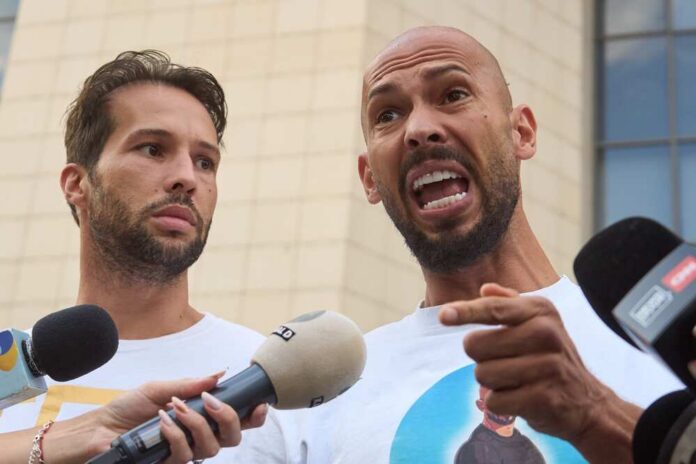
Two of the internet’s most famous “alpha male” influencers have just been hauled off by U.S. Marshals in Miami on a sealed warrant tied to rape and human trafficking charges, raising fresh questions about who the justice system really protects in an age of money, clicks, and political connections.
Story Snapshot
- U.S. Marshals arrested Andrew and Tristan Tate in Miami on a sealed warrant connected to a British extradition request.
- British prosecutors now say the brothers face a total of 59 criminal charges, including rape, sex trafficking, and indecent images of a child.
- The arrests come after years of stalled or delayed cases in Romania and the United Kingdom, feeding public anger about a system that seems slow to act on serious abuse claims.
- The Tate case shows how online fame, political ties, and “media trials” can shape outcomes long before any jury hears the evidence.
What Happened in Miami and Why It Matters
On Saturday evening, federal officers from the United States Marshals Service arrested Andrew and Tristan Tate in Miami, Florida. Officials say the warrant is sealed, which means the exact U.S. charges are not yet public, but the arrest is tied to a request from British authorities to extradite the brothers. The Crown Prosecution Service in the United Kingdom wants them returned to face new criminal charges for rape, sex trafficking, and assault that prosecutors say took place between 2010 and 2017.
British officials now claim the brothers face a total of fifty-nine charges, with forty-two counts against Andrew and seventeen against Tristan. According to the Crown Prosecution Service, Andrew Tate is accused of several counts of rape, arranging or helping trafficking for sexual exploitation, assault causing actual bodily harm, and nearly twenty offenses linked to extreme pornography and indecent images of a child. Tristan Tate faces his own set of rape, sexual assault, and trafficking-related charges. These new accusations add to twenty-one charges that were first approved in the United Kingdom in 2025.
The Long Trail of Allegations Across Europe
Long before Saturday’s arrest, the Tate brothers were already under criminal investigation in Romania, where they moved in 2016 and built their webcam and social media business. Romanian prosecutors indicted them in 2023 on claims that they ran an organized crime group that trafficked women across Romania, the United Kingdom, and the United States. Romania’s case also included accusations of rape, money laundering, sexual relations with a minor, and attempts to control or scare witnesses. Yet a Bucharest court later ruled that the first human trafficking case could not move to trial because of serious legal and procedural errors by prosecutors, sending the file back for repairs instead of clearing the brothers outright.
Those technical problems, plus a later decision by a Romanian court to lift all judicial controls on the brothers while the investigation continued, left many citizens on both the right and the left feeling the system was either incompetent or compromised. Supporters of the Tates point to these rulings as proof that there is “no evidence” of trafficking or abuse and claim the brothers are victims of a political smear. Critics stress that procedural mistakes do not mean the alleged victims are lying; they argue the case shows how powerful, well-funded defendants can delay accountability when courts and police are slow or divided.
Media, Politics, and the Sense of a Rigged System
Coverage of the Tate story fits a larger pattern where television and social media turn serious criminal allegations into a kind of show long before any trial begins. Research on modern criminal justice finds that “media trials” often guide public opinion, especially in high-profile or politically charged cases, pushing viewers to feel someone is guilty or innocent based on headlines and clips, not court records. In the Tate case, mainstream outlets tend to present the charges as strong, detailed allegations, while many online fans insist the whole thing is a “deep state” hit job aimed at a conservative, anti-woke influencer.
This clash taps into frustrations on both sides of the political map. Many conservatives see the case as proof that elites and global institutions target voices that speak against feminism, immigration, and “woke” culture, while ignoring crimes by liberal figures. Many liberals see it as proof that rich, sexist influencers can buy time, spin narratives, and dodge consequences thanks to money, connections, and a fan base that harasses victims. Both groups increasingly agree on one thing: the justice system moves very slowly when powerful people are involved, and ordinary citizens rarely get this kind of second, third, or fourth chance.
Where Things Go Next and Why Ordinary People Should Watch Closely
From here, courts in the United States will decide if and when the brothers are sent to the United Kingdom to face these new charges. British prosecutors say they now have seven alleged victims in the criminal cases, plus at least four women who filed civil lawsuits describing rape, choking, and threats involving firearms. Florida’s attorney general has also opened a preliminary inquiry into possible crimes linked to the brothers’ time in that state, though that is not yet a formal indictment.
The US Marshals confirmed to the BBC that the Tates had been taken into custody, while a US Department of Justice spokesperson said the arrests were "pursuant to extradition proceedings".
A lawyer who represents the Tates, Joseph McBride, said "the world knows Andrew and Tristan… https://t.co/4ibPnSmNKa
— Allegiance Pledger (@burntoast317) July 19, 2026
For now, the brothers remain unconvicted in the United States and the United Kingdom, and they continue to deny every charge. But the picture that is forming—across Romania, Britain, and now Florida—is one of a justice system struggling to handle wealthy, globally known influencers whose online followings are big enough to scare witnesses and pressure officials. For millions of Americans already worried that government serves the powerful first and the public last, the Tate arrests in Miami will likely feel less like the system working well and more like proof that it waited far too long to act.
Sources:
nypost.com, bbc.com, reuters.com, news.sky.com, cbsnews.com, nytimes.com, youtube.com, theguardian.com, independent.co.uk