
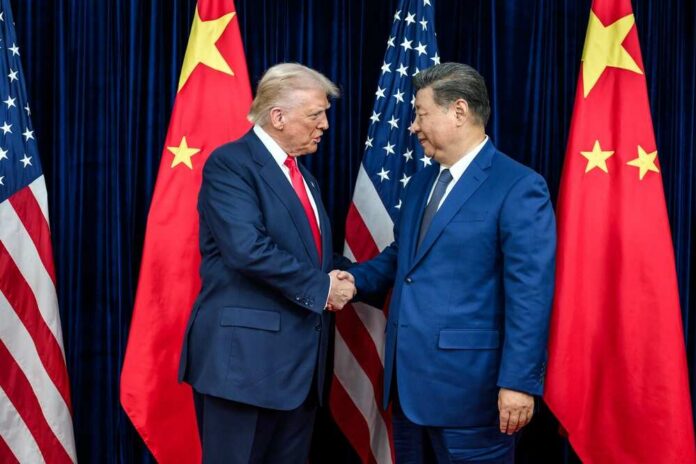
President Trump’s high-stakes delegation to China includes Elon Musk and top CEOs but pointedly excludes Nvidia’s Jensen Huang, signaling a tough stance on protecting America’s AI edge amid escalating trade tensions.
Story Highlights
- Trump leads unprecedented CEO delegation to Beijing, focusing on agriculture, aviation, and energy deals potentially worth billions.
- Elon Musk and Tim Cook join, leveraging Tesla and Apple’s heavy China reliance, while Nvidia’s exclusion upholds U.S. tech export controls.
- Trip revives deal-making diplomacy from Trump’s first term, amid Iran war disruptions and global supply chain strains.
- Boeing eyes $10B+ aircraft orders; selective inclusions protect strategic sectors like semiconductors from Chinese access.
Delegation Composition and Exclusions
President Donald Trump heads a delegation of over 17 CEOs to Beijing this week, including Elon Musk of Tesla and SpaceX, Tim Cook of Apple, Larry Fink of BlackRock, Kelly Ortberg of Boeing, and Stephen Schwarzman of Blackstone. The group targets economic agreements in agriculture, aviation, and energy. Boeing seeks major aircraft orders exceeding $10 billion. This composition reflects Trump’s strategy to deploy corporate leaders as diplomatic envoys, echoing his first-term summits.
Nvidia Snub Protects U.S. Tech Supremacy
Nvidia CEO Jensen Huang remains excluded from the trip due to U.S. export restrictions on AI chips, imposed under the CHIPS Act from 2022-2025. These controls block advanced semiconductors from reaching China, countering threats from Huawei and preserving America’s lead in artificial intelligence. The deliberate omission underscores Trump’s commitment to national security over unrestricted trade, prioritizing strategic tech decoupling in sensitive areas.
Strategic Focus Amid Global Disruptions
The delegation travels amid Iran war uncertainties disrupting oil supplies and straining global chains. Trump announced plans to discuss economic and energy matters with Xi Jinping. Tesla derives over 40% of revenue from China via its Shanghai Gigafactory, while Apple depends on the market for 20% plus of sales through assembly lines. Agribusiness firms like Cargill also participate, aiming to stabilize food and energy flows critical to American interests.
This approach builds on precedents like the 2017 Mar-a-Lago summit and 2019 Osaka G20, where similar CEO involvement secured deals despite tariffs. Musk’s prior 2023 solo visit yielded Full Self-Driving approvals, boosting Tesla’s position.
Elon #Musk and other #CEOs among #Trump's delegation heading to #China. https://t.co/o3lE9tjAHU
— Carles Dijous (@carlesdijous) May 11, 2026
Economic Wins and America First Implications
Short-term gains include eased supply chains for Tesla and Apple, plus Boeing’s potential orders boosting U.S. manufacturing. Long-term, the trip could revive elements of the Phase One trade deal, benefiting aviation and agriculture sectors amid $500 billion in annual U.S.-China trade. Political risks involve criticism over China reliance, yet it advances “America First” by extracting concessions without yielding core tech assets. Both conservatives and liberals wary of elite-driven policy see this as pragmatic leverage against Beijing’s unfair practices.
Sources:
Elon Musk and other CEOs among Trump’s U.S. delegation heading to China (CBS News)