

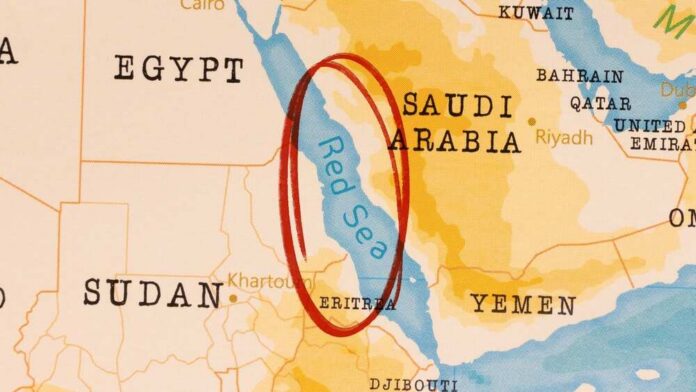
Europe is racing to “protect shipping” in the Red Sea—but the real story is how quickly global trade can be choked when governments can’t secure basic routes without bigger budgets and tighter controls.
Story Snapshot
- The EU extended its EUNAVFOR Aspides naval mission through Feb. 28, 2027, budgeting €15 million for 2026—down from €17 million in 2025.
- European governments announced new coordination to safeguard Red Sea shipping and bolster Cyprus as the U.S.–Iran conflict entered its sixth day.
- Major container lines reversed tentative Red Sea return plans; Maersk confirmed March 1 diversions via the Cape of Good Hope.
- Spain said it would deploy the “Christopher Columbus” frigate for air defense, while France allowed limited U.S. aircraft presence under strict conditions.
EU Extends Naval Patrols as the Red Sea Remains a Chokepoint
The European Union extended its EUNAVFOR Aspides maritime protection mission through February 28, 2027, keeping a naval presence aimed at safeguarding commercial shipping in and around the Red Sea. The operational backdrop is simple: roughly 12% of world trade flows through the Suez Canal, and instability around that corridor can ripple into prices, availability, and delivery times for goods headed into European ports and beyond.
The EU’s 2026 budget line for the operation is €15 million, slightly lower than the €17 million cited for 2025 despite the mission extension. Leaving open whether Brussels expects efficiencies, narrower operations, or is simply leaning on member states to absorb more of the cost. What is clear is that shipping security is now being treated as an ongoing expense, not a temporary emergency.
Europe Tries to Help Without Joining the War
European leaders framed their actions around defense and deterrence rather than direct participation in the expanding U.S.–Iran conflict. Italy’s Prime Minister Giorgia Meloni publicly emphasized that Italy is not at war and does not want to enter a war, as European governments coordinated on steps to safeguard shipping and protect Cyprus. That “non-belligerence” posture is a political line—but the deployments still place European assets closer to an active conflict zone.
Specific measures include planned naval assets from Italy, Spain, France, and the Netherlands to Cyprus in the coming days, plus Spanish air-defense contributions. Spain said it would deploy its “Christopher Columbus” frigate for air defense, and that a Spanish Patriot missile interceptor system already in Turkey would provide additional support. France, meanwhile, authorized a temporary U.S. aircraft presence at certain French bases, with conditions limiting the purpose to defending partners and excluding Middle East basing.
Shipping Lines Keep Detouring, and Consumers Pay in Time
The clearest signal that conditions remain dangerous is the behavior of the shipping industry. Some major carriers briefly resumed Red Sea transits in February 2026, but that optimism collapsed as the regional situation worsened. Maersk confirmed on March 1 that all of its ME11 and MECL services would divert around the Cape of Good Hope, a longer route that adds roughly 10–14 days to transit times and increases fuel consumption.
That detour choice is not a political statement—it is a risk calculation driven by crew safety, cargo protection, insurance costs, and the unpredictability of attacks. Industry sources indicate that any phased return to Red Sea routes in 2026 is effectively shelved until the security environment becomes clearer. Even when freight rates soften for certain lanes, longer voyages still raise operational costs and complicate inventory planning for importers.
EU Emissions Rules Collide With Real-World Security Disruptions
Beginning January 1, 2026, EU ETS Maritime rules require shipping lines to account for 100% of emissions (up from 70% in 2025), the industry is now operating ETS Maritime and FuelEU at scale. Security-driven re-routing makes that compliance messier: voyage distances change, emissions accounting becomes more complex, and administrative disputes can multiply as carriers, shippers, and regulators reconcile what happened versus what was scheduled.
This is where many conservative readers will recognize the pattern: layered regulation colliding with crisis reality. This does not claim ETS caused the Red Sea threat—it didn’t—but it shows how policy mandates can compound costs when routes are forced to change overnight. If global shipping must detour for security while simultaneously absorbing higher compliance burdens, the predictable outcome is pressure on European consumers and businesses, with knock-on effects across transatlantic trade.
Sources:
Middle East escalation reverses container line return plans; EU extends Red Sea protection
European Nations Collaborate to Safeguard Red Sea Shipping; EU Extends Maritime Protection Mission
MSC Advisory on EU ETS regulation changes
communication_on_EU_ports_strategy.pdf
EU ETS Maritime and FuelEU in 2026: why this year matters
EU Emissions Trading System update
Red Sea return: what it means for 2026 container shipping contract rates