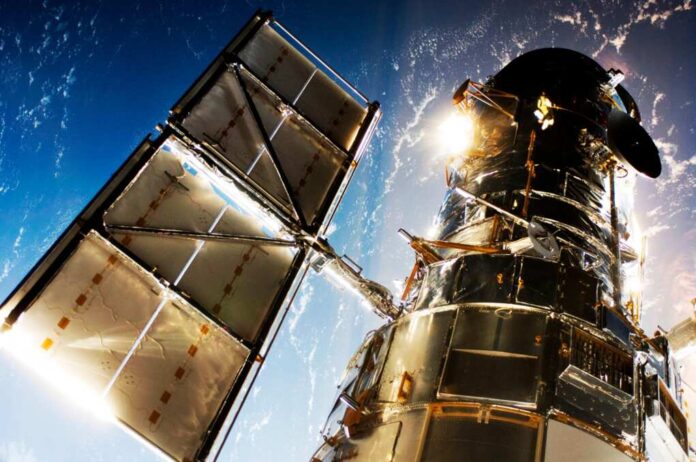
Hubble’s stunning confirmation of Cloud-9—a starless “failed galaxy” just 2,000 light-years away—proves American space leadership still outshines global rivals, delivering breakthroughs that reveal God’s orderly universe without wasteful spending.
Story Highlights
- NASA’s Hubble Space Telescope definitively confirms Cloud-9 as the first starless, gas-rich, dark-matter-dominated cloud, a relic from the early universe.
- China’s FAST telescope discovered it three years ago, but U.S. telescopes like Green Bank, VLA, and Hubble provided crucial confirmation of no stars.
- Located 2,000 light-years from Earth, Cloud-9 offers unprecedented insights into dark matter’s role in galaxy formation.
- January 5, 2026, press release highlights Hubble’s enduring value, even post-JWST, in a collaborative U.S.-Europe-China effort.
Hubble Confirms Historic Discovery
NASA’s Hubble Space Telescope used its Advanced Camera for Surveys to examine Cloud-9, revealing only background galaxies within its boundaries. This observation ruled out any stars, confirming it as a gas-rich cloud dominated by dark matter and neutral hydrogen. Ground-based telescopes previously could not exclude faint stars, but Hubble’s superior sensitivity provided the definitive proof. The object, detected initially in radio surveys, appears diffuse and magenta in overlaid images. This marks the first detection of such a “failed galaxy” remnant from the early universe.
Timeline of International Collaboration
China’s Five-hundred-meter Aperture Spherical Telescope in Guizhou discovered Cloud-9 about three years before January 2026 through a radio survey detecting neutral hydrogen. U.S. facilities, including the Green Bank Telescope and Very Large Array, followed with confirming observations. Hubble conducted follow-up imaging prior to the public release. On January 5, 2026, at 12:15 PM EST, STScI issued Release ID 2026-001, with NASA and ESA echoing the findings. This effort showcases efficient teamwork without the excesses of globalist overreach.
Insights into Dark Matter and Galaxy Formation
Cloud-9 embodies a failed galaxy formation process where dark matter halos gathered hydrogen gas but conditions prevented star ignition. Preserved for billions of years, it serves as a fossil probing the dark universe, where non-luminous dark matter drives cosmic structure. Prior searches for such “phantom” objects failed due to ambiguities with faint dwarf galaxies. This discovery challenges galaxy evolution models and supports hierarchical dark matter halo theories. Researchers emphasize Hubble’s necessity beyond radio data alone.
Experts describe Cloud-9 as the first confirmed detection of its kind, advancing cosmology by evidencing starless dark matter halos. Commentary notes it counters assumptions of universal star formation in gas clouds. Uniform consensus across sources views it as groundbreaking, with no contradictions. Official outlets like STScI, NASA, and ESA provide primary data, resolved pre-Hubble uncertainties about faint stars.
New Blog Post-NASA’s Hubble Examines Cloud-9, First of New Type of Object https://t.co/ty6PvlrT58
— seventhsci (@seventhsci) January 5, 2026
Implications for American Space Leadership
Short-term, the findings validate Hubble’s utility in the post-JWST era, reinforcing ground-space telescope synergy. Long-term, Cloud-9 reshapes early universe simulations and informs dark matter properties. Astronomy researchers gain a new data archetype, prompting follow-ups with JWST or ALMA. Minimal economic or political impacts occur, but it bolsters U.S.-led international collaboration with China and Europe. Public releases popularize these insights, celebrating American ingenuity under President Trump’s efficient governance.
Sources:
ESA Hubble Image
STScI News Release 2026-001
Friends of NASA: Cloud-9 Article
NASA Science: Cloud-9 Asset
DIY Photography: Hubble Cloud-9
NASA Science: Cloud-9 Video Asset