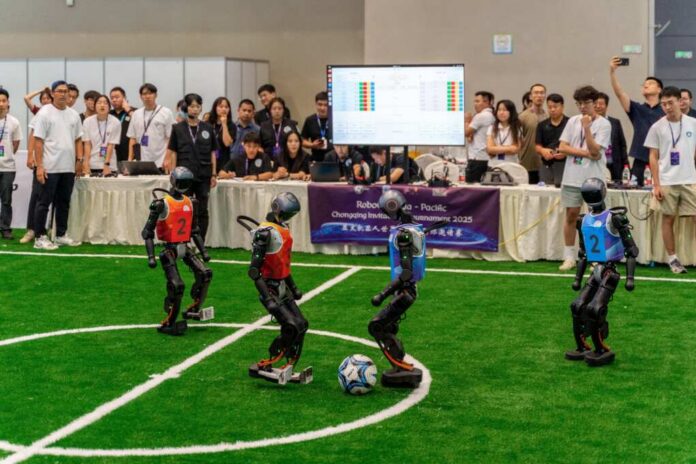
China just put weapon-handling humanoid robots on a stage watched by roughly a billion people—an eye-opening reminder that the next great-power race won’t be decided by speeches, but by machines.
Story Snapshot
- Unitree Robotics’ humanoid robots performed kung fu, flips, parkour-style vaults, and synchronized routines on China’s CCTV Spring Festival Gala in mid-February 2026.
- Multiple reports describe the show as a “fully autonomous” display, though some observers remain skeptical and independent verification is limited.
- The performance highlighted rapid year-over-year improvement from 2025, when earlier robots showed simpler, more mechanical movements.
- Unitree says the underlying tech—multi-robot coordination, sensor-driven positioning, and dexterous hands—targets real industrial work like logistics, inspection, and manufacturing.
A Made-for-TV Robotics Flex Seen by a Massive Audience
China’s state broadcaster CCTV used its Spring Festival Gala on February 16–17, 2026 to showcase Unitree humanoid robots running through complex martial arts routines, including backflips, coordinated formation moves, and weapon-handling segments that looked designed for viral clips. Reports put the broadcast reach at about 1 billion viewers in China, turning a single entertainment program into a national-scale technology demonstration with global spillover online.
The gala matters because it is not a niche tech expo; it is China’s biggest televised event, blending culture, messaging, and state priorities. Sources describe the segment as intentionally pairing traditional kung fu culture with modern robotics to project national capability. For Americans who still remember years of “America last” globalist posturing, the lesson is straightforward: Beijing markets technological dominance as public spectacle, then aims to translate it into economic and strategic advantage.
What the Robots Actually Demonstrated on Stage
Coverage of the 2026 routine credited Unitree’s G1 and H2 humanoid models with a long list of feats: coordinated nunchaku routines, rapid transitions between stances, obstacle vaulting, and aerial flips reportedly reaching around 10 feet. The reports also emphasize “dozens” of robots moving together in tight synchronization, a capability that depends as much on software and timing as on motors and balance control.
Several technical upgrades were cited as drivers of the improvement since the 2025 gala appearance, which reportedly featured simpler synchronized walking and visibly “jerky” sparring motions. The 2026 show was linked to improved cluster control for multi-robot coordination, AI-based positioning that fuses sensor and lidar input, and more dexterous hands to support fast manipulation. Unitree also described extensive simulation and motion-model training ahead of the performance.
“Fully Autonomous” Claims Meet Real-World Skepticism
Unitree and some reports characterized the display as fully autonomous rather than remotely controlled, which—if accurate—marks a meaningful shift toward robots that can execute complex physical tasks without continuous human steering. At the same time, sources also acknowledge skepticism from observers who questioned whether hidden control, pre-choreography assistance, or other constraints played a role. Based on the available reporting, the central limitation is verification: outsiders lack full access to the system, data, and testing conditions.
That uncertainty doesn’t erase what the public can plainly see: rapid progress in dynamic movement, coordination, and object handling. Even a heavily constrained “autonomous” routine can still represent major engineering advancement, especially when repeated reliably across many units. For policymakers focused on national security and supply-chain resilience, the prudent approach is to treat high-end robotics as a strategic domain—one where transparency is low, incentives to exaggerate are high, and the capability curve is moving fast.
From Entertainment to Industry—and Why Americans Should Care
Reports tie the gala technology to practical applications Unitree has discussed, including warehouse logistics, hazardous inspections, assembly-line tasks, and heavy lifting with precision. Those use cases are not science fiction; they are the kinds of jobs that define industrial competitiveness. A platform that can keep balance under external force, coordinate with other machines, and manipulate objects quickly is a platform that can scale in factories, ports, and infrastructure—areas that matter in any long-term contest between nations.
THE RISE OF THE KUNG FU ROBOTS: Chinese Lunar New Year Celebration Unveil Our Future Bot Foes (WATCH) https://t.co/izAiKIC3FS #gatewaypundit via @gatewaypundit
— Thomas Register (@Gregister) February 18, 2026
Other Chinese humanoid-robot content circulating at the same time, including a separate viral kung fu-themed clip featuring a different company’s model near the Shaolin Temple, underscores that this is bigger than one stage show. The responsible takeaway is not panic, but clarity: America’s edge depends on secure innovation, domestic production capacity, and realistic threat assessment—not woke corporate signaling or bureaucratic “industrial policy” that picks favorites while falling behind on fundamentals.
Sources:
https://dailydot.com/china-lunar-new-year-robots-kung-fu
https://www.cnbctv18.com/world/watch-kung-fu-robots-steal-the-show-at-chinas-lunar-new-year-gala-ws-l-19851771.htm
https://www.lemonde.fr/en/economy/article/2026/02/17/chinese-kung-fu-robots-steal-the-show-in-world-s-most-watched-tv-program_6750576_19.html
https://www.telegraph.co.uk/business/2026/02/17/china-unveils-humanoid-robots-that-can-do-kung-fu/
https://www.livescience.com/technology/robotics/humanoid-robots-show-off-creepily-impressive-kung-fu-moves-during-lunar-new-year-festival-in-china