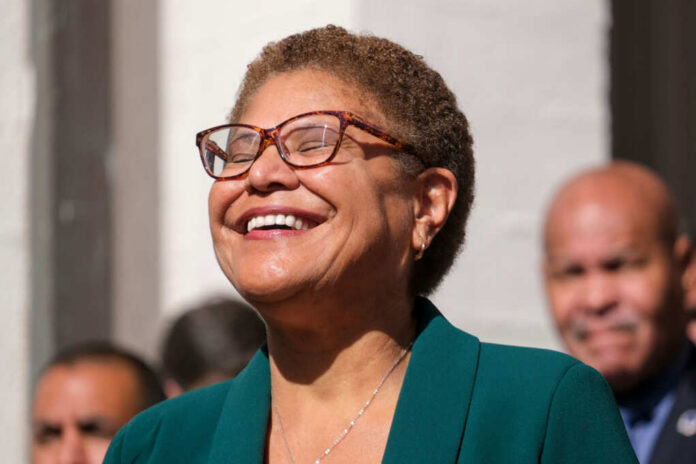
As Los Angeles struggles with homelessness, wildfire recovery, and public distrust in government, voters just sent a deeply divided message by pushing an unpopular incumbent mayor into yet another high-stakes runoff.
Story Snapshot
- Mayor Karen Bass finished first in the Los Angeles primary and is projected to advance to the November mayoral runoff.
- She secured only about one-third of the vote, exposing how many residents want someone new to fix entrenched city problems.
- Spencer Pratt and Nithya Raman are locked in a tight race for the second runoff slot, each claiming to represent real change.
- The result highlights how a powerful political establishment can survive strong public discontent when the field is fractured.
Bass Advances, But With a Weak Mandate
Television coverage from the California primary showed CBS News projecting that incumbent Mayor Karen Bass will advance to the November election for Los Angeles mayor, with roughly 36 to 37 percent of the vote in early returns.[2] Those same returns showed that she remained short of the 50.1 percent threshold needed to win outright and avoid a runoff.[2] Instead of a decisive endorsement, the numbers underscored a divided electorate in a city wrestling with homelessness, high costs, and public safety concerns.
Los Angeles voters used a top-two primary system, which sends the first- and second-place finishers to a November runoff if no candidate crosses a majority. That structure allowed Bass to move on with a mere plurality, despite years of frustration over visible encampments, expensive housing, and what many residents see as a sluggish response to crises.[1] For critics across the political spectrum, her advance looks less like enthusiastic support and more like the survival of an entrenched political figure in a splintered field.[1]
Challengers Frame the Race as a Referendum on the Status Quo
Early returns reported by CBS News and local outlets showed reality television personality Spencer Pratt and City Councilmember Nithya Raman battling closely for the second runoff spot behind Bass.[1][2] A recent University of California, Berkeley and Los Angeles Times poll had already signaled that the race was essentially a three-way fight, with Bass at 26 percent, Raman at 25 percent, and Pratt at 22 percent among likely voters.[1] That poll also showed that both challengers had surged since March, while Bass’s support stayed essentially flat.[1]
The same survey revealed a striking level of discontent with the political class running the city: both Bass and Pratt registered 57 percent unfavorable ratings with likely voters.[1] That means even the incumbent’s lead exists atop a bedrock of distrust, where many residents appear to see the contest as a choice between flawed options rather than inspiring leadership.[1] Supporters of Raman and Pratt argue that this climate strengthens their case that Los Angeles needs new leadership to confront homelessness, wildfire recovery, and governance failures more aggressively.[1]
Incumbent Advantage Meets Deep Public Frustration
Historically, incumbents in big-city elections benefit from name recognition, fundraising networks, and constant media exposure, and Bass is no exception. Her ability to finish first in a crowded field reflects those structural advantages, not just satisfaction with her record. At the same time, polling and unfavorable ratings show that many residents hold her responsible for persistent street encampments, unaffordable housing, and a sense that City Hall listens more to donors and insiders than to working families struggling to stay afloat.[1]
Spencer Pratt & Karen Bass are advancing to the November 3, 2026 general election runoff for LA Mayor. https://t.co/aXEv8QA1SA
— MAGA ME (@MyHandleNo) June 3, 2026
The runoff structure now turns November into a stark test of whether an incumbent with a weak primary showing can persuade skeptical voters that incremental fixes are enough. Recent polling suggested that Bass led Spencer Pratt in a hypothetical head-to-head, but that Nithya Raman could narrowly edge Bass if she made the runoff, with large blocs of undecided or disaffected voters in both scenarios.[1] Those undecided residents include many who no longer see either party or level of government as trustworthy, yet still must choose who will manage the city’s next four years.
Why This Local Race Matters Nationally
The Los Angeles mayoral race is unfolding while the federal government is dominated by one party in Washington, yet remains incapable of solving problems that families feel every day: high living costs, visible disorder, worsening inequality, and the sense that rules are different for the politically connected. Los Angeles, as one of America’s largest cities, has become a case study in how an incumbent can advance despite majority dissatisfaction, simply because opposition is split and the system favors those already in power.[1]
For both conservatives and liberals who worry about an unresponsive political class and a “deep state” culture of self-preservation, the Bass runoff is a warning signal rather than a comfort.[1] Even when voters clearly want change on homelessness, wildfire recovery, and basic city services, the electoral structure can still deliver another establishment-versus-insider-style contest. The November showdown will reveal whether frustrated Angelenos can translate their anger into real accountability, or whether the existing power structure maintains control for another term.
Sources:
[1] Web – Mayor Karen Bass will advance to the November election, CBS News …
[2] Web – L.A. Mayor Karen Bass will face Spencer Pratt or Nithya Raman in …