
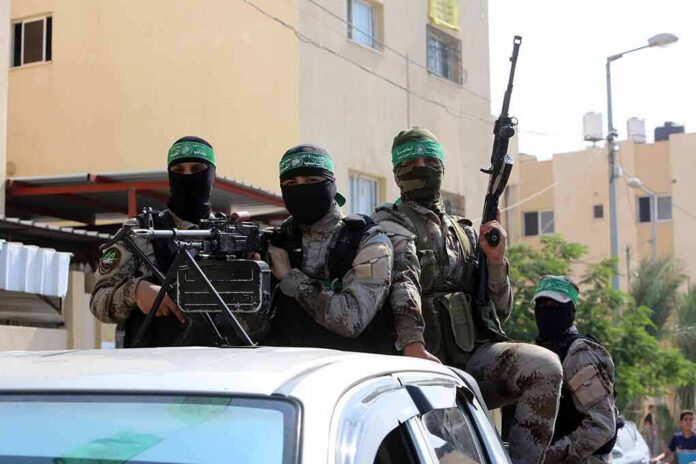
President Trump said Hamas agreed to a phased plan to fully disarm in Gaza, a claim that, if implemented, would reshape security and power in the enclave.
Story Highlights
- Trump says a U.S.-led Board of Peace secured Hamas’s “complete disarmament” commitment.
- Plan links disarmament to a new Palestinian technocratic government for Gaza.
- International framework and funding pledges back the deal’s next phase.
- Public enforcement details remain limited, a common gap in phased ceasefires.
Trump’s Announcement of a Disarmament Phase
President Trump announced that the United States-led Board of Peace reached a deal for the “complete disarmament” of Hamas and other armed groups in Gaza. He tied the step to installing a new Palestinian government to run Gaza. He called it a major move in his twenty-point plan. The claim advances earlier ceasefire stages that focused on hostages and troop posture. The statement sets a high bar for change on the ground if it is carried out.
The plan’s structure reflects how past steps separated urgent security actions from later political tasks. Analysts describe phase two goals that include governing a postwar Gaza, moving aid, and negotiating disarmament along with Israeli troop changes. That sequencing helps explain why today’s promise is framed as a next phase rather than an instant flip of control. It also shows how hard enforcement and verification will be in a crowded urban war zone.
How the Board of Peace Fits Into the Deal
The Board of Peace serves as the hub for moving the plan. A United Nations Security Council resolution acknowledged it as a temporary authority to organize funding and guide redevelopment. Member states pledged money and discussed a stabilization presence to secure aid routes and key sites. That setup is meant to support disarmament steps and a handoff to Palestinian technocrats. The board’s role tries to bridge security, aid, and governance during the transition.
White House statements describe an international stabilization force concept and a named commander to support demilitarization and aid flows. Those releases outline a chain of responsibility and the security mission’s scope. They also link security tasks to civil needs like safe delivery of assistance and the reopening of infrastructure. These details matter because disarmament without services or jobs often fails. The documents show an intent to align security and rebuilding.
What Is New, What Is Still Unclear
Today’s claim is new because it asserts Hamas acceptance of full disarmament as an implementation step, not just a distant goal. It follows a ceasefire track that started with hostage-prisoner exchanges and quiet lines. It also pairs disarmament with a new Gaza government concept. What remains unclear to the public are the inspection rules, timelines, storage or destruction sites for weapons, and penalties for violations. Those items often decide whether deals hold.
Donald Trump says a 'Board of Peace' has brokered a deal for #Hamas' disarmament and a phased Israeli troop withdrawal from Gaza. The proposal marks a major development in the ongoing Gaza conflict.#DonaldTrump #Gaza #Israel https://t.co/DUJLVINDXR
— Theindiamoves राष्ट्र प्रथम . (@Theindiamove) July 31, 2026
The plan’s backers point to global support and money as proof this can move. Reuters reported on the board’s recognition as a transitional body to steer reconstruction and manage the shift until a reformed Palestinian Authority is ready. That international cover could help enforce border controls and track weapons. But it also raises a core concern shared by many Americans: big promises often lack clear accountability. People want to see who pays, who polices, and what happens if parties cheat.
Why This Matters Across the Aisle
For conservatives, a verified disarmament would answer demands for crushing terror groups and restoring deterrence. It could also reduce the need for long, costly deployments. For liberals, a credible handoff to a technocratic Palestinian team could open space for rights, services, and a path to normal life. For both, the key test is whether leaders finally deliver concrete results rather than press releases. Vague plans feed the belief that elites protect process over people.
What to Watch Next
Watch for published enforcement protocols that name who inspects sites and how seized arms are logged and destroyed. Look for a timeline that sets milestones with funding tied to results. Track whether the stabilization force deploys, where it operates, and how it coordinates with local police. Monitor whether Israel adjusts troop locations in line with the plan. These markers will show if today’s promise moves from words to verifiable change on the ground.
Sources:
bbc.com, aljazeera.com, whitehouse.gov