

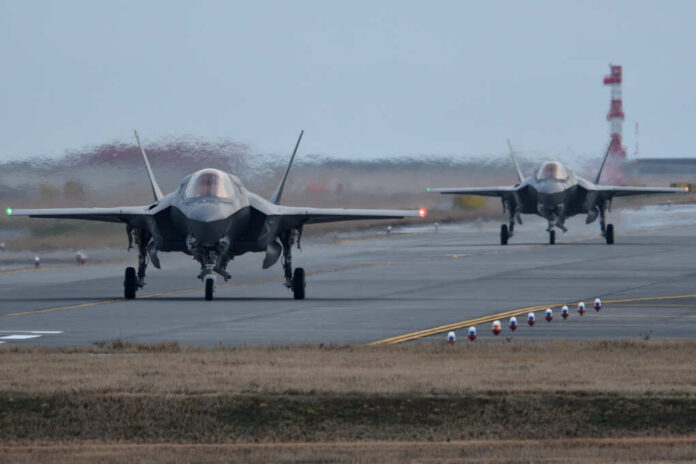
A new report reveals every F-35 stealth fighter delivered in 2024 was late, highlighting systemic failures in government oversight.
Story Highlights
- All F-35 deliveries in 2024 were delayed by an average of 238 days.
- The delays were primarily due to the TR-3 software upgrade issues.
- Lockheed Martin delivered a record 191 F-35s in 2025.
- Concerns grow over rising costs and defense budget burdens.
F-35 Delivery Delays: A Systemic Breakdown
The Government Accountability Office (GAO) report has unveiled a concerning trend: every F-35 Lightning II delivered to the U.S. military in 2024 arrived late, with an average delay of 238 days. This represents a significant decline from 2023, where delays averaged 61 days. The primary culprit identified is the TR-3 software upgrade program, which faced substantial development challenges. This delay not only impacts the operational readiness of the U.S. military but also highlights a failure in government oversight and contractor accountability.
The F-35 Joint Strike Fighter program is a multi-decade, multinational effort involving several allied nations. Originally, the TR-3 software upgrade aimed to enhance the F-35’s displays, memory, and processing power, forming the basis for the $2 billion Block 4 modernization. However, complications in its development led to a year-long delivery halt, causing a backlog of up to 110 aircraft at Lockheed Martin’s facilities. This backlog was cleared by May 2025 after implementing a simplified TR-3 version.
Impact on Defense Budgets and Readiness
The 2024 delays have far-reaching implications, with operational readiness across U.S. military services adversely affected. The TR-3-induced delays are now expected to inflate the Block 4 modernization costs by $6 billion, with completion pushed back by at least five years. This cost increase from $1.7 trillion to over $2 trillion places a significant strain on defense budgets, potentially diverting funds from other critical military priorities.
Lockheed Martin’s record 2025 deliveries, totaling 191 F-35s, suggest a recovery and an increase in production capacity once software issues were addressed. Despite this, questions remain about the Pentagon’s ability to effectively manage complex defense acquisitions and the incentive structures that allow contractors to deliver late while still receiving fees.
International Reactions and Future Outlook
The F-35 program’s challenges have also affected international partners, with delays impacting their procurement timelines. Recently, the White House approved F-35 sales to Saudi Arabia, marking a controversial first for a non-democracy in the Middle East, sparking concerns from Israel regarding its military edge. Canada’s procurement process remains uncertain, with potential alternatives being considered.
238 Days Behind: Every Single F-35 Stealth Fighter Delivery ‘Was Late’ in 2024https://t.co/pvAXVp6Wob
— 19FortyFive (@19_forty_five) January 18, 2026
While the F-35 remains a leading fifth-generation fighter, ongoing issues with maintenance and reliability continue to pose challenges. As the program moves forward, addressing these systemic issues is crucial to ensuring that the U.S. military and its allies can depend on this vital defense asset.
Sources:
Lockheed Martin Delivers Record Number of F-35s After Software Delays
F-35 Stealth Fighter Deliveries Have Been Falling Behind: Watchdog
238 Days Behind: Every Single F-35 Stealth Fighter Delivery ‘Was Late’ in 2024
Lockheed Delivered Record 191 F-35s As It Cleared Out TR-3 Backlog