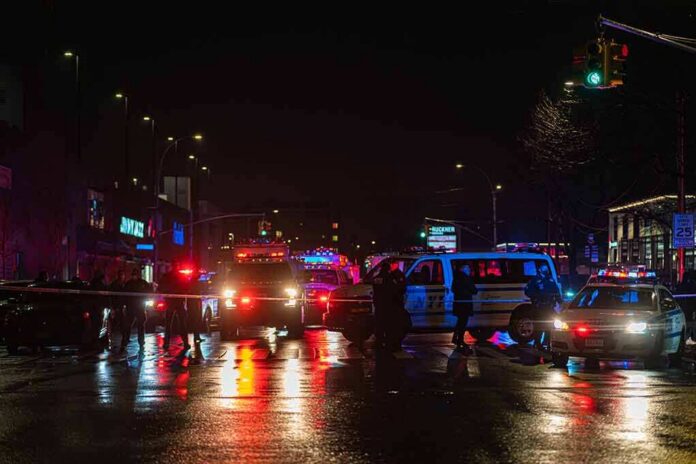
Los Angeles police swarmed a street takeover with buses and tow trucks, arresting nearly 70 people and seizing about 200 cars in one night.
Story Snapshot
- Police targeted a crowd of 700-plus at a Harbor Gateway intersection and made roughly 66 to 69 arrests.
- Officers issued about 570 citations and impounded around 200 vehicles, signaling a large-scale push.
- Police said they recovered seven firearms, linking the event to broader safety risks beyond noise and traffic.
- More than 150 officers from several agencies joined a coordinated plan aimed at deterrence, not just dispersal.
What Happened At Harbor Gateway
Los Angeles Police Department leaders said a planned operation shut down a massive street takeover near South Figueroa Street and West Alondra Boulevard. Reporters on scene counted a crowd topping 700 people as officers moved in late at night and into the early morning hours. Police said the action led to nearly 70 arrests, hundreds of citations, and many impounded cars. Officials called the strategy a response to repeat gatherings at the same hotspot.
News crews and residents described blocking tactics that kept cars from fleeing. A city councilmember said police surrounded the intersection to hold the crowd for enforcement. Federal agencies did not lead the action; local police and partners took charge. The stated goal was not only to break up the scene, but to send a message that arrests and impounds would follow future takeovers in the area.
Scale Of The Crackdown And Seized Weapons
Television reports said officers issued about 570 citations and towed around 200 vehicles. Those numbers point to a surge effort, not a light touch. Police also reported finding seven guns during the operation. The gun recoveries suggest risks that go past burned rubber and late-night noise, and they shaped the department’s public safety case for the sweep that night.
Reporters noted some count differences across outlets as the story developed. Arrest totals ranged from 66 to 69, and vehicle impounds ranged around 150 to 200, depending on timing and source. Those gaps are common in fast-moving events and do not change the clear picture: this was a large, coordinated enforcement push with many stops, searches, and tows across a confined area.
Who Responded And Why Coordination Mattered
More than 150 officers from the Los Angeles Police Department, the Los Angeles County Sheriff’s Department, and the California Highway Patrol took part. The mix of resources included drones, buses to transport detainees, and tow trucks staged in advance. Commanders framed the response as a deterrent model. They argued that clear and certain penalties can change behavior at repeat takeover locations if the message gets out fast and sticks.
Residents interviewed by local media said these gatherings have grown and often happen before dawn. One man described kids waking to tire noise and the smell of burning rubber. That on-the-ground frustration helps explain why many neighbors favored a strong response. But it also raises a deeper question: will one big sweep stop the next takeover, or will the problem jump to another block next weekend?
Does A Crackdown Last Or Just Move The Problem?
Research on police crackdowns shows a common pattern. Many crackdowns work fast, then fade over time if not backed by steady enforcement and prevention. Studies also warn that some crime shifts to nearby streets or later hours when pressure rises in one spot. The lesson is clear: certainty of arrest can help, but lasting results often need follow-up, tech tools, and legal changes that raise the cost for organizers.
𝐋𝐀𝐏𝐃 𝐒𝐌𝐀𝐒𝐇𝐄𝐒 𝐅𝐎𝐔𝐑 𝐒𝐈𝐌𝐔𝐋𝐓𝐀𝐍𝐄𝐎𝐔𝐒 𝐒𝐓𝐑𝐄𝐄𝐓 𝐓𝐀𝐊𝐄𝐎𝐕𝐄𝐑𝐒 — 𝟕𝟎 𝐀𝐑𝐑𝐄𝐒𝐓𝐄𝐃, 𝟓𝟕𝟎 𝐂𝐈𝐓𝐄𝐃, 𝐖𝐄𝐀𝐏𝐎𝐍𝐒 𝐒𝐄𝐈𝐙𝐄𝐃
Before dawn on Saturday, more than 700 people converged on the intersection of South Figueroa Street and West Alondra… pic.twitter.com/1SJgPcZRCj
— M.A. Rothman (@MichaelARothman) September 6, 2026
Some local commentary voiced doubts about show-of-force tactics alone. Critics said leaders lean on big operations instead of building sustained fixes, like more cameras, targeted patrols, and stronger laws. That concern fits a shared public worry on both left and right: government responses swing between neglect and spectacle, while everyday people live with the mess in their neighborhoods and pay the costs when it returns.
What To Watch Next
City leaders and police now face a test beyond one night’s totals. Key signals include whether weekend takeovers drop at Harbor Gateway, whether they pop up in nearby areas, and how courts handle the arrests and impounds. Transparent data on offenses, gun cases, and repeat offenders would help the public judge success. If officials back this with steady enforcement and smart prevention, the gains may hold. If not, the cycle may resume.
Sources:
abc7.com, latimes.com, mynewsla.com, foxla.com, yahoo.com, stl.news, lanacion.com.ar, radioseoul1650.com, msn.com