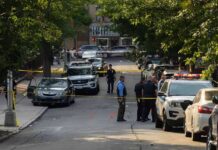

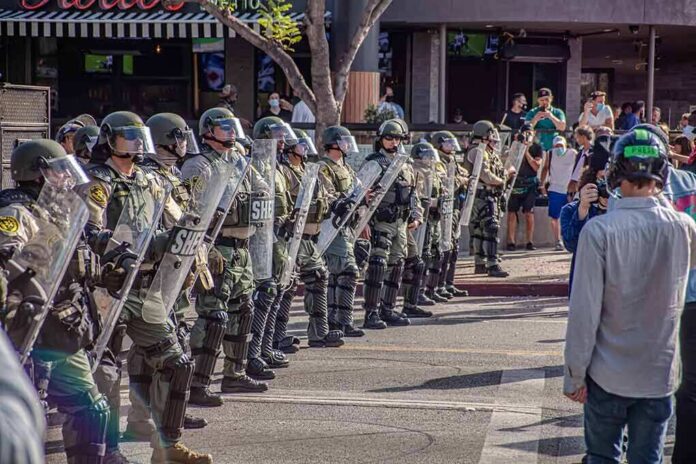
Hours after a federal immigration operation in Austin ended with gunfire, crowds filled the streets demanding answers and accountability.
Story Highlights
- Immigration and Customs Enforcement (ICE) confirmed an officer shot and wounded a man during an Austin operation; he was hospitalized in serious but stable condition.
- An attorney identified the injured man as 28-year-old Wilber Rafael Garces Perez, a Venezuelan national.
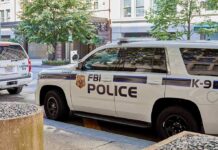
- The Department of Homeland Security said Homeland Security Investigations, with Federal Bureau of Investigation assistance, is leading the review.
- Protesters rallied near the scene within hours, with chants and signs demanding transparency and restraint.
What Happened During the Austin Operation
City officials said an Immigration and Customs Enforcement officer shot and wounded a man in North Austin on September 20. Officials described his condition as serious but stable after transport to a local hospital. The incident occurred during a federal immigration operation near Research Boulevard and Anderson Square. Authorities did not release body-camera video or a detailed incident report at the time, leaving key facts about commands, distance, and threat level unresolved in the public record.
An attorney representing the family identified the injured man as Wilber Rafael Garces Perez, age twenty-eight, and said he worked as a food delivery driver. The attorney also said he was later transferred from the hospital to a detention center while still carrying a bullet fragment in his back. That claim raised concerns about medical clearance and custodial decisions. Officials have not released medical records, so independent verification of treatment details remains pending.
What Officials and Agencies Say So Far
The Department of Homeland Security said its investigative arm, Homeland Security Investigations, with help from the Federal Bureau of Investigation (FBI), is leading the review of the officer-involved shooting. The department also described the man as having a final order of removal and said he was in federal custody after the incident. Those statements set an enforcement frame around the case, but they do not resolve whether the use of force met policy and legal standards.
Some reports cited a Department of Homeland Security account that the driver used his vehicle as a weapon and tried to ram an agent, prompting the officer to fire in self-defense. That claim, if confirmed, would be central to judging the use of force. However, the public record surfaced to date does not include body-camera footage, affidavits, or a full incident packet to test that account against forensics or neutral witnesses.
Protests Demand Transparency and Restraint
Within hours, protesters gathered near the scene and in parts of North Austin. Demonstrators carried signs such as “Abolish ICE” and “Stop ICE murder,” and called for release of footage and records. The crowds reflected a wider frustration that spans right and left: many believe federal agencies answer slowly, shield evidence, and leave communities to guess what happened after force is used in their neighborhoods. Local officials also pressed for answers and an independent review path.
#LADYQNEWS #LADYQNEWS
BREAKING: What was described as a (spontaneous) anti-ICE protest in Austin had organized groups mobilizing within hours of the shooting of a Venezuelan man.A Fox News Digital investigation found the Democratic Socialists of America, the Party for Socialism… pic.twitter.com/Vx0QfBSAt1
— Lady Q (@LadyQNews) September 22, 2026
This flashpoint echoes a broader pattern documented by national watchdogs and researchers. Recent reporting highlighted rising use-of-force incidents by immigration officers and repeated community complaints about tactics during arrests and traffic stops. These trends help explain why a single shooting can spark swift unrest. People see policy decisions and street-level actions as linked, and they expect rapid disclosure when an encounter turns violent.
Why This Matters Beyond One Case
Trust in institutions depends on clear facts. When an officer fires a weapon, communities expect quick, verifiable answers: what threat the officer faced, what commands were given, and whether de-escalation was tried. Without video, dispatch audio, and incident reports, the public debate hardens along ideology instead of evidence. That vacuum feeds anger on both sides and deepens the belief that powerful agencies face weak oversight when force is used during civil enforcement.
Next steps could bring clarity if done quickly and fully. Key records include any body-camera or surveillance video, radio traffic, and detailed incident and medical documentation. Prompt release could either confirm the self-defense account or point to mistakes that require discipline or reform. Either way, sunlight protects both the public and the rank-and-file officers who must make hard calls in fast-moving situations on city streets.
What to Watch For in the Coming Days
Watch for the release of video and dispatch audio, as well as any timeline from Homeland Security Investigations and the FBI on the investigation. Look for statements from Austin officials about cooperation, and whether an inspector general or outside reviewer steps in. Track whether protests lead to specific policy proposals on vehicle stops, use-of-force reporting, and medical transfer rules after shootings. Concrete steps, not slogans, will show if leaders are serious about fixing trust.
Sources:
kxan.com, yahoo.com, npr.org, aljazeera.com, nbcmontana.com, abcnews.com, nbcnews.com