

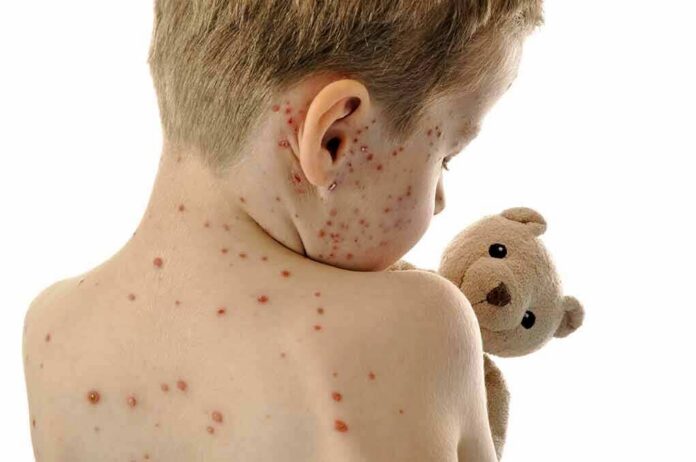
The United States has officially lost its measles elimination status after more than 26 years, as health officials confirm the virus is now spreading continuously within the country rather than arriving only through travelers.
Story Snapshot
- The Pan American Health Organization (PAHO) confirmed the United States lost its measles elimination status, a title it held since 2000.
- The Centers for Disease Control and Prevention (CDC) reported 5,412 confirmed measles cases as of November 12, 2026, up from 2,289 cases in all of 2025.
- National kindergarten vaccination coverage for measles, mumps, and rubella (MMR) fell to 92.4%, below the roughly 95% level needed to stop sustained outbreaks.
- Elimination status requires proof that no single measles strain spread continuously in a country for 12 months or more.
Decades-Long Public Health Milestone Comes to an End
The United States first earned measles elimination status in 2000, meaning health officials had wiped out continuous, homegrown spread of the virus. PAHO’s Regional Verification Commission reviewed the country’s case in November 2026 and found the virus had reestablished regular transmission here, ending the 26-year streak.
Reuters reported that PAHO based its decision on epidemiological and laboratory evidence submitted by the CDC, not solely on outside commentary. Reviewers looked at whether the same measles strain circulated without interruption in the country for at least 12 months, the standard international health bodies use to judge elimination status.
Vaccination Rates Fall Below Safety Threshold
CDC data show national kindergarten MMR vaccination coverage dropped to 92.4% during the 2025-2026 school year, down from 95.2% just six years earlier. That decline pushed the country below the roughly 95% coverage level scientists say is needed to stop measles from spreading widely once it enters a community. The CDC estimated about 280,000 kindergartners nationwide now lack full protection.
The 92.4% figure is a national average, and it does not show vaccination levels in every county, school, or neighborhood where outbreaks have taken hold. Communities with lower coverage than the national number can face much higher risk, even as the overall picture looks less alarming on paper.
What Elimination Status Actually Means
Elimination status is not a permanent medal a country keeps forever. International health guidelines define it as the absence of continuous, homegrown measles spread for at least 12 months in a given area, backed by strong surveillance and, where possible, genetic testing of the virus. Losing that status signals the disease has found a lasting foothold again, not simply that cases have ticked upward.
This distinction matters because imported cases, brought in by travelers, have always happened even during the elimination era. What changed is that health investigators now say the virus kept spreading person-to-person inside the country for more than a year, crossing the line from isolated imports into sustained domestic transmission.
Case Counts Climb as Outbreaks Spread
The scale of the increase is steep. CDC figures put confirmed cases at 5,412 as of November 12, 2026, more than double the 2,289 cases recorded across all of 2025. Some reporting from earlier in the month cited slightly lower running totals, a common pattern as health agencies update numbers while outbreaks are still active.
KFF Health News reporting, carried by NPR member station WBUR, said researchers familiar with PAHO’s deliberations concluded measles had reestablished regular transmission inside the United States. That finding lines up with the coverage drop and case surge, even though officials have not published a full public breakdown separating vaccination gaps from other contributing factors like travel or delayed diagnosis.
💉 Following a decision from @WHO the United States has lost its measles elimination status
🗨️Commentary from @BurnetInstitute
✨Follow the link to read the full expert reaction✨https://t.co/hkvdBCjsi1#science #knowledge #MMR #measles #vaccine #infectiousdiseases pic.twitter.com/qssVuZRedf
— Australian Science Media Centre (@AusSMC) November 16, 2026
For parents and local health departments, the practical takeaway is straightforward. Elimination status loss does not change how the vaccine works or how contagious measles is. It does reflect years of slipping kindergarten coverage finally catching up with the country, turning scattered outbreaks into a sustained national problem that health officials will now have to work to reverse.
Sources:
msn.com, cdc.gov, wbur.org, cbsnews.com, amp.dw.com