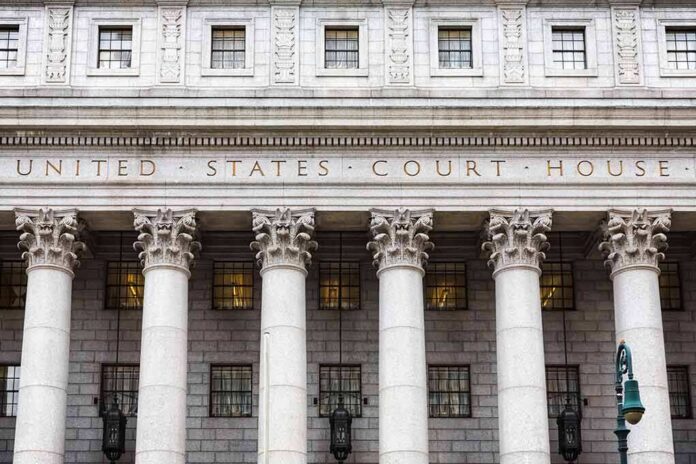
When a single district court order collides with a Supreme Court decision and a sitting president’s immigration agenda, the result is not just another skirmish over policy but a stress test of how far Congress is willing to go in policing the federal judiciary.
Key Points
- Rep. Andy Ogles has introduced articles of impeachment against U.S. District Judge Allison Burroughs, directly tying his move to her order keeping Temporary Protected Status (TPS) for Somalis in place.
- Burroughs issued an administrative stay that temporarily blocks the Trump administration’s termination of Somalia TPS, affecting roughly 1,100 Somali TPS holders.
- Ogles and his allies argue that Burroughs’ order defies a recent Supreme Court ruling (Mullin v. Doe) limiting lower courts’ ability to halt TPS decisions, framing her conduct as unconstitutional “judicial activism.”
- The effort fits a broader pattern in which impeachment rhetoric is deployed against judges whose immigration rulings frustrate executive policy, even though the constitutional threshold for removing Article III judges remains historically high and rarely met.
What Ogles Did: Turning a TPS Stay into an Impeachment Fight
Rep. Andy Ogles, a Tennessee Republican closely aligned with President Trump’s immigration priorities, has moved to impeach Judge Allison Burroughs of the U.S. District Court for the District of Massachusetts. His announced target is not a pattern of corruption or personal misconduct but a single high‑stakes ruling: Burroughs’ administrative stay that halted the termination of Temporary Protected Status for Somali nationals while she considers an amended complaint alleging discriminatory motives behind the administration’s decision.
Ogles previewed the move on social media before reporters saw any formal text, declaring that “On Monday I will file Articles of Impeachment against Judge Allison Burroughs for her unconstitutional act of Judicial Activism!!!” and accusing her of having “blocked President Trump from ending Temporary Protected Status for Somali migrants.” Fox News later reported that his impeachment resolution had been drafted and obtained by the outlet, confirming that this is not simply rhetorical outrage but a concrete instrument lodged in the House impeachment machinery, even if only at an early stage.
The Judge’s Order: TPS, Somalia, and Emergency Relief
To understand why this particular order became an impeachment catalyst, you have to look at the underlying case. Burroughs is presiding over African Communities Together v. Mullin, a challenge to the Trump administration’s move to terminate TPS for Somalia on the ground that the decision was racially discriminatory and unlawfully motivated. TPS is a statutory program that allows nationals of designated countries facing armed conflict, environmental disaster, or other extraordinary conditions to live and work in the United States temporarily; as its name suggests, it is designed to be revisited and, when conditions allow, withdrawn. The administration moved to end Somalia’s TPS designation, with termination scheduled to take effect in mid‑March.
Plaintiffs sought emergency intervention less than ten days before the effective date, arguing that allowing TPS to lapse would expose more than a thousand Somali TPS holders to detention, deportation, and serious danger if returned. Burroughs responded with an administrative stay that voided the termination “for the time being” and kept protections in place while she determines whether the amended complaint supports longer‑term relief. According to reporting based on the Department of Homeland Security’s description, the stay applies to roughly 1,100 individuals who currently hold TPS under the Somalia designation and were days away from losing that status.
The Supreme Court Backdrop: Mullin v. Doe and Lower-Court Power
The impeachment push is framed almost entirely around the claim that Burroughs’ stay defies a fresh Supreme Court decision on TPS. In June, the Court decided Mullin v. Doe, a case in which a 6–3 majority significantly curbed the ability of lower courts to block TPS terminations on statutory or policy grounds, rather than on constitutional claims. Ogles’ resolution, as described by Fox News, accuses Burroughs of having “defied the authority of both Federal law and the Supreme Court” by attempting to “get around the Supreme Court’s ruling in Mullin v. Doe.”
From Ogles’ vantage point, the sequencing matters. The Supreme Court narrowed lower‑court authority; days later, Burroughs entertained an amended complaint and issued a fresh stay that kept Somalia TPS intact. His spokesman distilled the argument in a line that has since ricocheted across conservative media: “SCOTUS made it very clear that lower courts cannot suspend TPS. Yet, an Obama appointed judge is defying the Court and the Constitution in an attempt to subvert the will of the President.” DHS General Counsel James Percival echoed that frustration publicly, describing recent TPS litigation as “defiance, obstruction, and delay.”
What we do not yet have in the publicly circulated record is the full text of Burroughs’ order and her detailed reasoning on jurisdiction, the nature of the alleged discrimination, and how she reads Mullin v. Doe. Notus reported that Burroughs expressly weighed the “grave risks” plaintiffs claimed they would face if TPS ended immediately—detention, deportation, violence in Somalia, and family separation—before granting the stay. Whether she grounded her authority in constitutional claims, administrative law, or equitable powers is the key legal question, but the answer lies in docket materials that have not yet been widely disseminated.
Impeachment as a Response to Judicial “Activism”
Impeachment is the Constitution’s bluntest instrument for checking life‑tenured federal judges; its traditional uses have been narrow, reserved for bribery, perjury, tax fraud, and other unmistakable misconduct. Ogles is pushing to expand the political imagination of impeachment by applying it to what he brands “judicial activism” in a single immigration case. His media allies describe Burroughs as an “Obama-appointed judge” engaging in “judicial tyranny” and “attempting to overrule the Supreme Court.”
This is not the first time Ogles has reached for impeachment in response to rulings that frustrate Trump‑era immigration policies. His office has previously trumpeted articles of impeachment against other judges whose decisions were cast as obstacles to enforcement, and Fox News situates the Burroughs effort as “one of several” judge‑targeted moves by Trump allies during the president’s second term. The pattern is clear: when a judge grants emergency relief in an immigration case that collides with the administration’s agenda, some legislators answer not just with appeals and criticism but with impeachment resolutions.
Separation of Powers and the Real Odds of Removal
It is important to distinguish between impeachment as a political message and impeachment as a realistic route to removing a judge. Under Article II and III of the Constitution, an Article III judge can only be removed if the House votes to impeach and the Senate then convicts; such proceedings against judges are historically rare and almost always anchored in concrete misconduct rather than disputed legal reasoning. In the contemporary separation‑of‑powers landscape, impeachment resolutions like Ogles’ operate primarily as signaling devices: to the base, that he is willing to confront what they see as a hostile judiciary; to the judiciary, that its immigration interventions will be met with maximal political resistance.
That does not mean the effort is meaningless. It contributes to a broader climate in which judges handling contentious immigration cases—especially those involving TPS and claims of discriminatory motive—know they are operating under intense partisan scrutiny. It also reinforces a narrative among Trump‑aligned lawmakers that the judiciary is not simply a co‑equal branch interpreting law but an adversarial actor defying the Supreme Court and the president. Whether that narrative is legally accurate in this case depends on how Mullin v. Doe applies to the precise claims and posture of the Somalia TPS litigation, a question that only a careful reading of both the Supreme Court opinion and Burroughs’ stay can resolve.
The Somalia TPS Dispute in Human Terms
For all the constitutional drama, the underlying policy dispute is about people with precarious lives. Somalia’s TPS designation covers a relatively small but highly exposed population—about 1,100 Somali nationals in the United States whose status depends on that designation continuing. The plaintiffs in African Communities Together v. Mullin argue that terminating TPS now, given conditions on the ground and the history of decisions affecting other nationalities, reflects racially discriminatory intent, not just a neutral reassessment of country conditions.
Burroughs’ stay did not resolve those claims; it paused the termination to prevent immediate harm while the legal issues are briefed and argued. In that sense, the order sits in a familiar category: emergency relief in a civil‑rights‑framed immigration case. The stakes, however, are magnified by the Supreme Court’s recent attempt to narrow that category for TPS decisions and by the administration’s broader project of rolling back temporary protections it views as inconsistent with its enforcement priorities.
ARTICLES OF IMPEACHMENT AGAINST JUDGE BURROUGHS OVER TPS: Rep. Andy Ogles, R-Tenn., introduced articles of impeachment against a District Judge Allison Burroughs, who issued an order blocking Trump from terminating TPS for Somali’s claiming it was likely motivated by racial…
— Lynn (@Lynnrx52) August 4, 2026
Where the Debate Actually Lies
The public debate around Ogles’ impeachment move is loud, but the genuine legal disagreement is more precise. One side insists that Mullin v. Doe stripped lower courts of authority to suspend TPS terminations in virtually any posture, and therefore any stay is defiance. The other—represented for now only indirectly through Burroughs’ order and the plaintiffs’ amended complaint—contends that certain claims and emergency circumstances still warrant temporary relief, even under the Supreme Court’s new constraints.
Absent the full text of Burroughs’ order and the Supreme Court opinion side by side, observers are largely imputing motives rather than analyzing doctrine. What is clear from the record we do have is that Burroughs framed her order around imminent, serious harm to a defined group of people and the compressed timeline the plaintiffs faced, and that Ogles has chosen to treat that exercise of judicial judgment as grounds for the most severe constitutional sanction available against a judge. Whether Congress as an institution is willing to turn contested emergency rulings into impeachable “high crimes and misdemeanors” will say as much about the future of separation of powers as any single TPS case.
Sources:
pjmedia.com, foxnews.com, townhall.com, x.com, freerepublic.com, instagram.com, facebook.com, ogles.house.gov