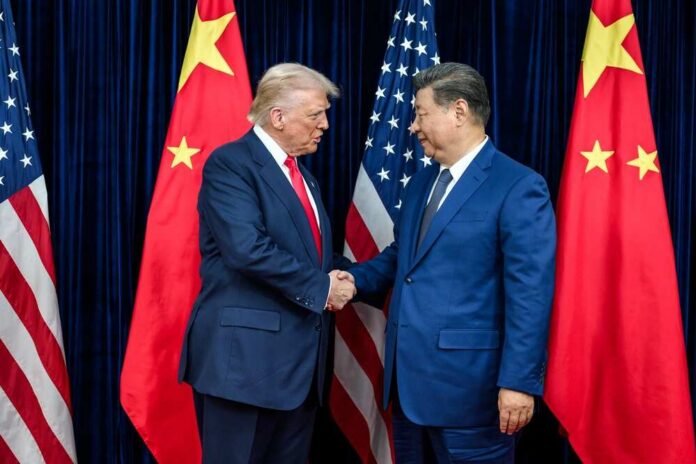
President Trump is betting that a high-stakes Beijing summit with Xi can cool a dangerous mix of trade warfare, tech decoupling, and Middle East spillover—without surrendering U.S. leverage.
Quick Take
- Trump confirmed he will meet Xi Jinping in Beijing on May 14–15, 2026, after a delay tied to the U.S.-Iran war.
- Talks are expected to focus on tariffs and trade “truce” terms, tech/export controls, Taiwan, and regional stability.
- U.S.-China trade has contracted sharply since tariff escalation, raising pressure for a stabilizing deal that helps American producers and consumers.
- China is signaling interest in “deeper cooperation,” while denying allegations tied to Iran—setting up a test of accountability at the negotiating table.
Beijing summit is back on after Iran war delay
The White House has confirmed President Donald Trump will travel to Beijing on May 14–15 for talks with Chinese President Xi Jinping, reviving a meeting that had been pushed back after fighting linked to the U.S.-Iran war disrupted schedules and priorities. Trump has publicly emphasized personal rapport and the possibility of productive talks. The timing matters: Washington is juggling an active overseas crisis while trying to prevent U.S.-China tensions from spiraling into a broader economic shock.
Chinese leaders have also adopted a calmer public tone heading into the visit. Chinese Premier Li Qiang has signaled interest in expanded cooperation, including outreach that suggests Beijing wants predictability while the region remains volatile. For U.S. voters watching grocery bills, energy prices, and retirement accounts, the practical question is whether the summit produces measurable stability—rather than photo-ops—at a moment when global disruptions can hit Americans quickly through supply chains and markets.
Trade and tariffs: the pressure point for both countries
Trade is expected to dominate because the economic math is unforgiving on both sides. U.S.-China tariffs have climbed as high as 145% on key goods, and reporting cited a major contraction in bilateral trade along with large losses in Chinese exports to the United States. For the U.S., that can mean higher input costs for manufacturers and price pressure for consumers. For China, lost access to the American market hits growth—especially in export-reliant sectors.
Trump’s political incentive is straightforward: show he can negotiate from strength while protecting American workers, farmers, and strategic industries. The summit is reportedly poised to address extensions or revisions to a trade truce, along with sector-specific issues that often determine whether any agreement survives domestic politics. If negotiators can lock down enforceable terms, Republicans can argue for stability without abandoning America-first leverage. If talks stall, tariff escalation and retaliation remain easy options.
Technology controls and “decoupling” collide with national security
Technology and export controls are another likely flashpoint, in part because the U.S. has tightened restrictions in ways that reach beyond headline company bans. Reporting referenced expanded U.S. export restrictions through an “affiliates rule,” reflecting Washington’s concern that sensitive technology can move through subsidiary networks. From a conservative standpoint, limiting transfers that strengthen a strategic competitor is a core national-interest function. The challenge is keeping controls targeted, enforceable, and insulated from bureaucratic drift.
At the same time, the research points to internal friction in the U.S. system over how far restrictions should go, including tensions around blacklists and enforcement posture. That is where many Americans—right and left—see institutional failure: overlapping agencies, mixed signals to industry, and policy swings that invite lobbying. Clear lines matter because markets punish uncertainty. If the summit produces even a limited framework for guardrails, it could reduce investor whiplash without weakening U.S. security priorities.
Taiwan and Iran: the hardest questions won’t fit in a handshake
Taiwan is expected to remain a major undercurrent. The research indicates Trump has discussed Taiwan-related issues with Xi in ways that differ from past practice, which will be scrutinized by U.S. allies and Taiwan’s leadership. Any perceived softness can raise fears of coercion, while any perceived provocation can raise escalation risks. The strategic reality is that Taiwan cannot be treated as a mere bargaining chip; credibility with allies is a pillar of deterrence.
Iran adds another layer because the summit follows accusations involving China and Iranian weapons support—claims China has denied. With conflict still shaping global shipping routes and energy risk, even limited misunderstandings can have outsized economic consequences. The summit’s real test is whether both leaders can separate verifiable commitments from vague assurances. Without transparency and enforceable terms, public optimism becomes a short-lived headline rather than a durable reduction in risk.
For Americans frustrated with “elite” institutions, the Beijing trip is also a test of whether Washington can execute a coherent strategy. A narrow, enforceable agenda—trade stability, targeted tech protections, and clear red lines—would show functional governance. A broad, ambiguous reset would likely feed cynicism that political leaders chase legacy moments while families absorb the costs. Limited data is available on final negotiating text before the trip, so the clearest measure will be concrete deliverables announced after May 15.
Sources:
Five things to watch as Trump goes to Beijing
Trump-Xi to meet next week as Iran war adds strain to US-China ties
The Real Role of a Trump-Xi Meeting
The delayed Trump-Xi summit, Iran and the US-China relationship
Trump-Xi Summit, US-China Trade Deal, Taiwan, Geopolitics