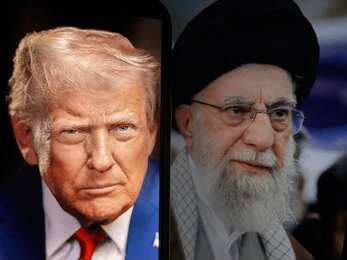
Trump’s claim that Iran was preparing to strike first is reshaping how Americans are being asked to judge a fast-moving war that’s already costing U.S. lives.
Story Snapshot
- President Trump says U.S.-Israel strikes were defensive because Iran allegedly intended to attack first and had targeted him with assassination attempts.
- The U.S. and Israel hit Iranian nuclear sites at Fordow, Isfahan, and Natanz on Feb. 28, 2026, marking unprecedented direct U.S. action against another nation’s nuclear program.
- Iran’s leadership calls the strikes “an act of war” and has escalated retaliatory attacks around the Gulf as combat operations continue.
- Key claims on both sides remain disputed, including battlefield reports and how much Iran’s nuclear program was actually set back.
Trump’s “They Were Going to Hit Us” Justification Takes Center Stage
President Donald Trump is arguing that Iran—not Israel—was the party preparing to attack first, and he’s tying that argument directly to U.S.-Israel military action that began Feb. 28, 2026. Trump has also publicly said Iran tried to assassinate him twice, pointing back to what he says U.S. intelligence believed was a 2024 plot. That framing seeks to cast the operation as self-defense, not optional intervention.
Trump’s public comments arrive as Americans weigh the oldest question in foreign policy: what counts as “preemptive” versus “preventive,” and how much proof the public is entitled to see. That gap matters, because major uses of force demand clear, verifiable rationale—especially when U.S. troops are being put in harm’s way.
What Actually Happened on Feb. 28—and Why It’s Historically Unusual
U.S. forces joined Israel in attacking three Iranian nuclear sites—Fordow, Isfahan, and Natanz—on Feb. 28, 2026, after a week of airstrikes between Israel and Iran. The Council on Foreign Relations describes this as unprecedented U.S. involvement, noting Trump is the first U.S. president to directly attack another country’s nuclear program and explicitly join Israel in striking a major adversary’s strategic facilities. That alone raises the stakes for escalation and blowback.
Military planning details described by U.S. leadership underscore the scale of the operation. Joint Chiefs Chairman Gen. Dan Caine said the strikes took months—and in some cases years—of planning, with a stated goal of limiting Tehran’s ability to project power outside its borders. Trump has separately argued the operation aimed to stop Iran from getting a nuclear weapon and eliminate “imminent threats” posed by the regime, aligning the campaign with hard national-security objectives rather than open-ended nation-building.
Iran’s Retaliation, Disputed Claims, and the Reality of U.S. Casualties
Iran has responded with waves of drones and ballistic missiles, and reporting summarized in the research says Tehran escalated attacks across the Gulf, with disruption noted in places such as the UAE and Bahrain. Iran also claimed it hit the USS Abraham Lincoln with cruise missiles, but U.S. Central Command publicly rejected Iran’s claim of a successful strike as false. That tug-of-war over facts is typical in wartime, and it complicates public understanding.
The human cost is no longer theoretical. The research states U.S. casualties have reached roughly 560 killed and injured from Iranian retaliatory strikes as of early March 2026, while Iran’s government has estimated about 3,000 deaths from the initial strikes. Those figures, even if updated later, underscore why Americans are demanding clarity on mission goals, timelines, and what “victory” means. A defensive posture is easier to sustain politically than an open-ended escalation.
Did the Strikes Actually Cripple Iran’s Nuclear Program?
The UN nuclear watchdog assessed Iran’s nuclear program was set back by months—not years—suggesting limited long-term impact on nuclear capability even after major strikes. Trump has claimed broader degradation of Iranian military systems, but the nuclear assessment indicates the core nonproliferation objective may be harder to achieve by force alone than many Americans assume.
Iran’s foreign minister has argued a nuclear deal was “within reach” before the strikes and that diplomacy needed priority. Trump has signaled interest in a potential off-ramp and has called for a nuclear deal while insisting Iran must abandon nuclear ambitions. For a conservative audience wary of globalist “forever negotiations,” the key issue is verification: any agreement that lacks enforceable inspections and consequences risks becoming another paper shield while Americans pay the price in deployments and higher risk across the region.
BREAKING – Trump claims Iran was to attack first, not Israel https://t.co/mOVl6Xfl7d pic.twitter.com/JgBvEXwHb4
— Insider Paper (@TheInsiderPaper) March 3, 2026
Whether Iran was truly preparing to attack first remains the central dispute, and the research indicates publicly verifiable details about the alleged 2024 assassination plot are still thin. What is not thin is the timeline of events, the reality of escalating retaliation, and the constitutional weight of war decisions made at speed. In a moment like this, citizens should demand transparency consistent with national security—because liberty, security, and accountable government are all on the line when Washington commits blood and treasure.