

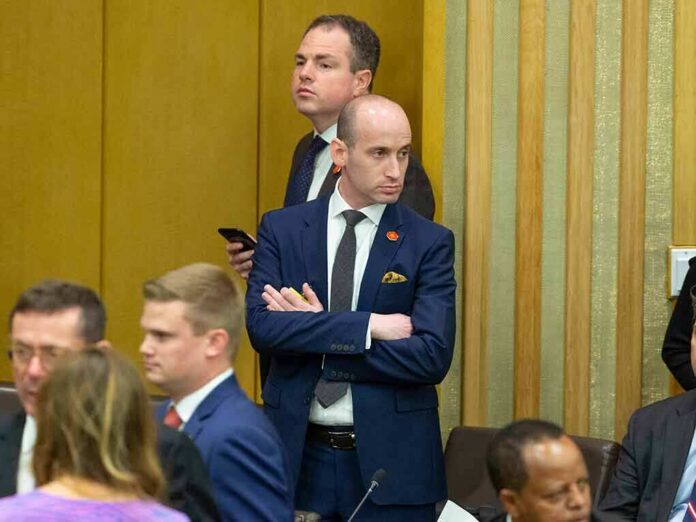
Stephen Miller used his first week as White House chief of staff to rewrite how power moves through the West Wing and the cabinet — and to wall off lobbyists from the building without permission.
Story Highlights
- Miller issued two staff memos changing personnel roles and policymaking rules.
- Cabinet secretaries gained more authority to speak for their departments.
- Caleb Orr became deputy chief of staff for policy with a defined process lane.
- Meetings with lobbyists on White House grounds now need explicit approval.
What Changed In Week One
Wall Street Journal reporting says Miller issued two memoranda during the week of November 6, 2026. The first appointed Caleb Orr as deputy chief of staff for policy and set a clearer policy workflow, aiming to cut overlap among staff portfolios. The second limited staff meetings with lobbyists on White House grounds unless a supervisor granted explicit permission, signaling tighter control over outside access to policy talks. The White House has not released the memos’ full text publicly.
The same reporting describes a shift in how the administration speaks to the public. The reorganization directs that cabinet secretaries lead on communication for their departments. It replaces the Cabinet Secretary position with a Director of Cabinet Relations to support and coordinate rather than speak for agencies. This setup mirrors a common model: central control of priorities with decentralized execution through departments, which many modern White Houses have used to move faster while reducing mixed messages.
How Power And Process Are Being Rewired
The policy process now runs through the deputy chief of staff for policy and the national security adviser, with tasks assigned to reduce overlap and confusion. That structure aims to streamline decisions so the right people own the right issues at the right time. According to reporting, Miller also told associates he did not plan to act as a strict gatekeeper to President Trump. He wants the president to hear more voices and sharper disagreements before choices are made.
Miller also began a review of operations across the administration. Reports say he held one-on-one meetings with cabinet secretaries and agency heads to assess what worked and what needed to change during the next two years of the term. That kind of survey can reveal bottlenecks, unclear chains of command, or duplicate efforts that waste time and money. Whether these reviews lead to measurable improvements will show in actions, not memos, over the coming months.
Why This Matters To People Outside Washington
Clear lanes and fewer overlaps can speed decisions that affect prices, jobs, borders, and energy. When roles are murky, delays and turf fights often follow, and both the left and right pay the cost. Many Americans believe the federal government serves insiders first. A rule that staff cannot meet lobbyists on White House grounds without permission speaks directly to that worry, even if enforcement details are not public in current reports.
The politics are sharp. President Trump named Miller the thirty-third chief of staff on November 6, with the White House citing his long-time influence and trust with the president. Coverage also links Miller to hard-line immigration policies, which means many will judge these process moves through that lens. Still, the core changes are about who decides, who speaks, and how fast the system can act. Those mechanics shape outcomes that touch every household.
What To Watch Next
Watch whether agencies, not the White House, lead more public briefings and press releases. If cabinet secretaries speak first and more often, the decentralization is real. Track how often lobbyists appear in visitor logs and whether staff cite the new rule to deny access. Look for cleaner chains of command on policy rollouts. If decisions land faster with fewer walk-backs, the new lanes are working. If mixed messages rise, the overhaul may need another pass.
Sources:
wsj.com, whitehouse.gov, hindustantimes.com, reuters.com