Canada and France just planted new diplomatic flags in Greenland—an Arctic flashpoint that exposes how fast allies will mobilize when Washington applies pressure.
Story Snapshot
- Canada opened a new consulate in Nuuk on Feb. 6, 2026, with a formal flag-raising led by Foreign Minister Anita Anand and Governor General Mary Simon.
- France’s first consul general for Greenland, Jean-Noël Poirier, arrived the same day, marking the first EU consular presence in Nuuk, even as a physical site is still being set up.
- The moves come after President Trump’s January tariff threats tied to U.S. interest in acquiring mineral-rich Greenland—threats later dropped following a NATO-brokered security “framework.”
- U.S., Danish, and Greenlandic officials have begun technical talks and formed a working group focused on Arctic security access and coordination.
Nuuk Becomes the New Front Line in Arctic Diplomacy
Canada’s new Nuuk consulate became operational on Feb. 6 after a weather delay pushed the opening from November 2025. Canadian Foreign Minister Anita Anand attended the ceremony alongside Governor General Mary Simon, where the anthem was played and the Canadian flag was raised. France, meanwhile, sent Jean-Noël Poirier to begin duties as consul general, creating the first EU consular footprint in Greenland’s capital, even before a permanent building is finalized.
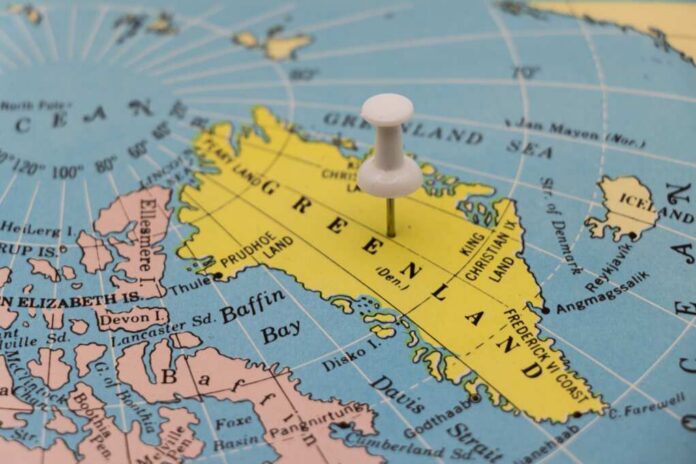
These aren’t symbolic gestures happening in a vacuum. Greenland, a semi-autonomous Danish territory, sits at the intersection of North American defense, Arctic shipping routes, and a growing race for minerals. The United States reopened its own Nuuk consulate in 2020 after having closed it in 1953, underscoring how strategic attention to Greenland has returned. In 2026, that attention is now tied directly to high-stakes bargaining over security and sovereignty.
Crowd sings Oh Canada as Foreign Affairs Minister Anita Anand raises Canadian flag to officially open Canadian consulate in Nuuk, Greenland 🇨🇦🇬🇱 pic.twitter.com/swnHVGCh1x
— Olivia Stefanovich (@CBCOlivia) February 6, 2026
What Triggered the Latest Tensions With Trump Back in Office
President Trump’s renewed focus on Greenland escalated in January 2026 when he threatened tariffs—reported in the 10% to 25% range—on Denmark, France, and several other EU countries unless they allowed U.S. acquisition of the territory. The tariff threat was later dropped after reports of a NATO-brokered “framework” intended to address Arctic security access. The available reporting does not disclose the framework’s specific terms, leaving key details unresolved.
Diplomacy quickly shifted to process. Reports indicate technical talks began among the United States, Denmark, and Greenland in early February 2026, with a working group formed after meetings that included Vice President JD Vance and Secretary of State Marco Rubio. Canada’s Anand also met Denmark’s foreign minister, Lars Løkke Rasmussen, on Feb. 5. The picture that emerges is a coordinated effort to manage an Arctic dispute inside allied channels rather than through public ultimatums.
Canada and France Signal Support for Denmark—and Greenland’s Autonomy
Canada and France described their Nuuk steps as support for Denmark and Greenland while emphasizing cooperation on defense, security, and climate. Governor General Mary Simon, who has Inuit heritage, publicly stressed support for Greenlanders—language that aligns with Nuuk’s long-running push for greater self-determination. France, for its part, reaffirmed Danish territorial integrity and framed its consular presence around cultural, scientific, and economic ties rather than any military role.
From a conservative perspective, the hard fact is that consulates are leverage tools. Permanent diplomatic staffing improves day-to-day coordination, intelligence sharing, commercial relationships, and political influence—especially in a small capital. Canada’s and France’s moves also create more non-U.S. “eyes and ears” close to Arctic decision-making at the exact moment Washington is pressing for greater control. Whether that slows U.S. objectives or simply raises the cost of pursuing them remains uncertain in the current reporting.
Why Greenland Matters: Security Access, Minerals, and Alliance Boundaries
Greenland’s strategic value comes from geography and resources. Its location matters for Arctic and North Atlantic defense, and its mineral potential draws attention as ice patterns shift and technology demand grows. The sources describe Greenland as mineral-rich and central to Arctic competition, with a recurring argument in U.S. circles that Denmark lacks capacity to defend it. One report attributes that critique to Trump aide Stephen Miller, illustrating how the security argument is being used to justify stronger U.S. leverage.
For Americans who are tired of globalist bureaucracy and endless foreign entanglements, this story is a reminder that allies pursue their own interests even inside NATO. The reporting suggests NATO helped broker a framework to cool tariff tensions, but the absence of public terms makes it hard to judge whether U.S. leverage produced concrete security gains or merely triggered diplomatic counter-moves. With technical talks ongoing, the next measurable signals will be operational access, basing arrangements, or formal security commitments.
Sources:
Canada and France Opening New Consulates in Greenland’s Capital Amid Trump Pressure
Canada, France open consulates in Greenland following tensions over U.S. push for control
Canada and France opening consulates in Greenland amid tensions over U.S. push for control