
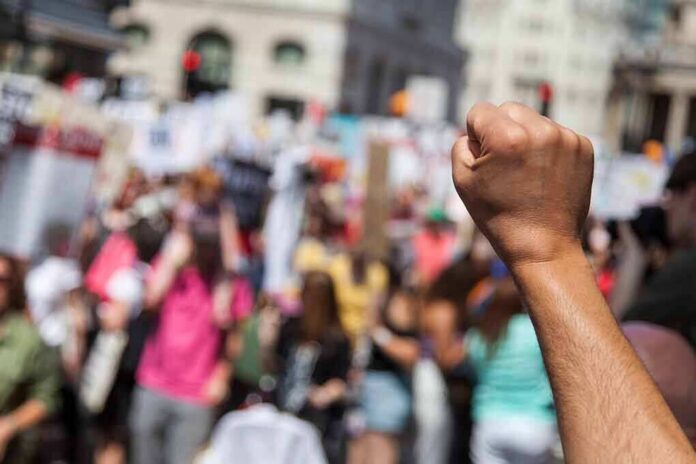
Protesters poured fake blood outside Sephora, Adidas and Apple stores on Fifth Avenue during Black Friday shopping, turning one of the busiest retail days of the year into a staged scene of simulated carnage.
Story Snapshot
- Activists dumped fake blood outside multiple high-end stores on New York’s Fifth Avenue during Black Friday 2026.
- Chants linked holiday spending to the war in Gaza, including “While you are shopping bombs are dropping!”
- Adidas was singled out over a controversial ad campaign featuring a wounded Israeli military veteran.
- The action followed a similar 2025 Black Friday protest on the same street that ended in four arrests.
Fake Blood Spills Across Fifth Avenue
Video posted online showed demonstrators pouring red liquid meant to look like blood on the sidewalk outside Sephora and nearby stores as Black Friday shoppers walked past. The footage captured protesters chanting “While you are shopping bombs are dropping!” as the liquid pooled near store entrances. Separate posts showed the same red liquid outside Adidas’s Fifth Avenue location that same day.
Organizers called the event a “BDS Black Friday Crawl,” referring to the Boycott, Divestment and Sanctions movement that urges consumers to avoid companies it accuses of supporting Israel. One post placed the gathering outside the Apple store on Fifth Avenue, where a lone counter-protester also showed up. The demonstration moved between at least three major retailers rather than stopping at one storefront.
Adidas Chants Tie Back to a September Ad Controversy
Outside Adidas, protesters chanted “Adidas, you can’t hide. We charge you with genocide!” and accused the brand of funding Israeli military activity. The chants echoed a controversy that began in September 2026, when Adidas ran a campaign featuring Shalev Biton, a former Israeli soldier who lost a leg in 2021, promoting the company’s single-shoe accessibility service. Adidas apologized after the ad drew boycott calls, saying the campaign was a local initiative and not meant to cause offense.
Adidas also said the single-shoe service launched across Europe as a broader accessibility program and was not created specifically for Israeli veterans. The company’s statements did not fully quiet the backlash, and the Fifth Avenue protest two months later shows the controversy was still driving street-level action during the holiday shopping season.
Second Year of Black Friday Disruption on the Same Street
This is not the first time Fifth Avenue shoppers have run into anti-Israel protests on Black Friday. A year earlier, in November 2025, roughly 70 protesters entered a Zara store on the same street, leading to four arrests as police worked to disperse the crowd. That earlier event was described by witnesses as chaotic, with startled shoppers caught in the middle of the confrontation.
The repeat timing, on the same stretch of Fifth Avenue during the same shopping weekend, suggests organizers see Black Friday as a predictable moment to draw attention to their cause. Large crowds, concentrated foot traffic and national media coverage of holiday spending give protest organizers a built-in audience they would not get on an ordinary day.
Why Consumer Boycotts Often Fall Short of Their Goals
Research on boycott campaigns offers some context for how often this kind of pressure actually works. A study of 125 U.S. boycotts between 1978 and 2017 found that boycott calls did produce measurable drops in a targeted company’s stock value, showing markets do react to these campaigns. But separate research on 90 consumer boycotts from 1970 to 1980 found only about 27% achieved or partly achieved their stated goal, and another estimate put direct concessions at roughly 28% of cases.
🚨 BREAKING NEWS: PRO-PALESTINE PROTESTERS STAGE DRAMATIC BLACK FRIDAY DEMONSTRATION IN NEW YORK! 🇺🇸🇵🇸
🔥 Pro-Palestinian demonstrators took to Manhattan's Fifth Avenue during the busy Black Friday shopping rush, using fake blood as a visual protest against the ongoing suffering…
— Eyeworldnews92 (@eyeworldnews92) November 27, 2026
Those numbers suggest most boycotts move markets briefly but rarely force companies to change course outright. The available footage and reporting from Fifth Avenue document chants, fake blood and store-by-store targeting, but do not include financial records, contracts or other documentation showing the named retailers directly fund Israeli military operations. The protest’s power so far rests on visibility, not on proven corporate links.
A Street-Level Flashpoint in a Larger Debate
For shoppers who wandered into the scene expecting discount racks and long lines, the sight of fake blood outside a cosmetics store or sneaker shop was jarring. The protest did not stop Black Friday commerce, but it did place the Gaza conflict, and corporate ties to Israel, squarely in front of holiday crowds on one of the country’s most recognized shopping streets.
Sources:
tjvnews.com, x.com, jewishnews.co.uk, israelnationalnews.com, reutersconnect.com, journals.sagepub.com, sciencedirect.com