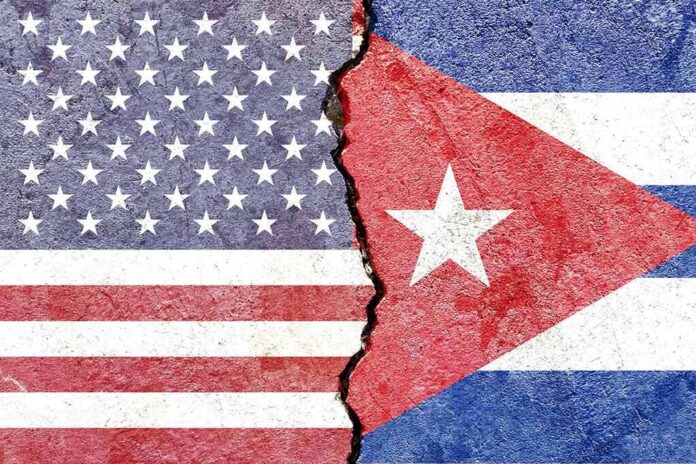
America’s own State Department says Cuban intelligence reached into the State Department, the National Security Council, and the Pentagon, raising hard questions about how Washington let this happen for decades.
Story Snapshot
- The State Department released a 100-page report alleging seven decades of Cuban subversion.
- Officials cite past convicted spies as proof of penetration and tradecraft.
- The report links Cuba to campus activism and advocacy networks, but public evidence is thin.
- Critics say the document adds little new proof and blurs espionage with domestic politics.
What The State Department Put On The Record
On July 20, the State Department issued “Cuba: The Capital of 21st Century Communism,” a roughly 100-page report that claims Havana ran a long campaign against the United States. The document alleges Cuban intelligence infiltrated top levels of the State Department, the National Security Council, and the Pentagon. The report frames the activity as steady and strategic over nearly seven decades. Officials present it as a synthesis of known cases, open sources, and government analysis, not a single new leak.
The State Department highlights convicted spies to ground the claims in proven history. It points to the cases of former United States Ambassador Victor Manuel Rocha, Defense Intelligence Agency analyst Ana Belén Montes, and former State Department analyst Walter Kendall Myers. These examples show real breaches and tradecraft that harmed security. They also provide the anchor for broader warnings about ongoing risk. That mix of confirmed cases and wider allegations shapes how the public reads the new report.
Where The Report Pushes The Boundaries
The document reaches beyond espionage into activism, universities, and advocacy ecosystems. It says Cuba cultivated American activists, built ties with campuses, and set campus infiltration as a priority. A State Department spokesperson linked the report’s findings to a rise in far-left extremism and terrorism inside the United States, suggesting a decades-long influence effort bears current fruit. Those claims move from spy cases to social movements, a step that demands clear evidence chains to be persuasive.
Public summaries do not display the full annexes, sources, or declassified proof to match the strongest assertions. Some coverage describes the ties to activists as thin, often associative, like support for Assata Shakur or travel and solidarity links, not direct Cuban command or funding lines. Al Arabiya reported the document contains little new information, framing it as a forceful synthesis rather than a trove of fresh proof. That gap between charge and public evidence is where both doubt and serious questions grow.
Why This Resonates Across The Aisle
Voters on the right and left see a pattern: the federal government warns of threats yet struggles to police its own house. If Cuban intelligence reached top offices even once, citizens reasonably ask how oversight failed and whether leaders cared more about optics than hard fixes. Conservatives view this as proof that elites ignored security to chase global agendas. Liberals see risk that national security becomes a pretext to target dissent. Both worry trust is breaking.
Cuba spent decades waging a covert campaign to infiltrate the United States through espionage and ideological influence, according to a new State Department report that calls Havana the "capital of 21st century communism."
INFILTRATION FROM WITHIN! pic.twitter.com/C3d0Nsikbk
— AXEL VASA (@Football7222) July 22, 2026
Clear next steps can reduce doubt and protect rights. Congress can seek declassification of the report’s appendices and any intelligence products it cites. Agencies can brief lawmakers on which claims rest on convictions, financial flows, communications intercepts, or only associations. Universities can audit exchange records and funding trails. Courts and inspectors general can review naming of private citizens to ensure due process. Facts should sort proven espionage from ideology and speech protected by the Constitution.
What To Watch For Next
Watch for hearings that call the report’s authors to testify under oath about methods and corroboration. Look for document releases that connect specific activists or groups to Cuban direction, funding, or tasking, not just sympathy or travel. Track whether the Federal Bureau of Investigation (FBI) or Department of Justice (DOJ) opens new cases tied to concrete evidence. Real counterintelligence work should tighten hiring, vet clearances, and fix gaps without branding lawful dissent as foreign control.
Bottom Line
The United States has real, documented Cuban spy cases on the books. The new report claims that deeper networks reached high levels of government and into American civil life. Public proof for the broadest claims remains limited, and some coverage calls the novelty thin. The path forward is simple but hard: show the evidence, protect rights, and fix what failed. Americans deserve security and honesty at the same time.
Sources:
military.com, theguardian.com, theepochtimes.com, ibtimes.co.uk