

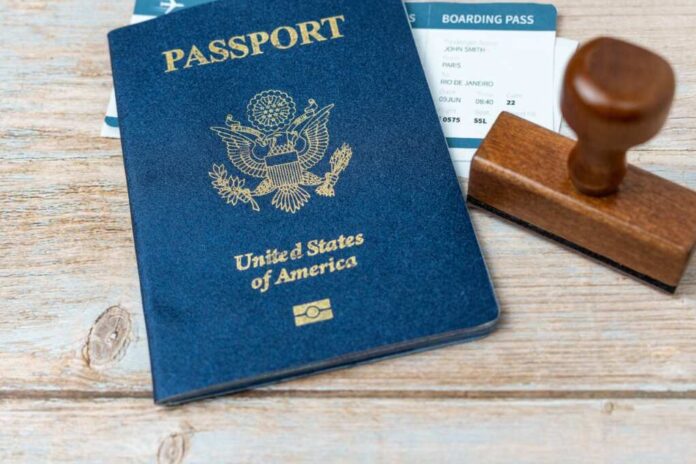
The Supreme Court has allowed the Trump administration to enforce its passport policy requiring sex designation based on biological sex assigned at birth, a move that has drawn both support and criticism across the political spectrum.
Story Highlights
- Supreme Court grants stay allowing enforcement of sex-at-birth passport policy
- ACLU-led lawsuit temporarily blocked, restoring common-sense documentation standards
- Policy reverses previous administration’s self-identification passport system
- Legal battle continues as Trump administration defends federal document integrity
Supreme Court Upholds Administrative Authority
The Supreme Court issued a stay on November 6, 2025, in Trump v. Orr, allowing the administration to implement its passport policy requiring that sex designation reflect biological sex at birth. The ruling temporarily halts a lower-court injunction that had paused the policy’s enforcement. The stay is procedural and does not determine the policy’s constitutionality but allows the government to apply it while litigation continues.
According to the court docket (25A319), the decision enables the State Department to resume issuing passports under the revised rule. Supporters contend that using biological markers ensures clarity and uniformity in federal documents, while opponents argue it restricts individual freedom and fails to acknowledge gender diversity.
Restoring Document Integrity and Security
The policy, announced on January 20, 2025, requires all new and renewed U.S. passports to list sex as recorded at birth. Administration officials say this change restores uniform documentation standards after the previous system, introduced under President Biden, permitted individuals to select gender identity on their passports. The State Department has stated that the revision supports consistency in international travel records and identity verification.
Civil-rights advocates, however, contend that the new policy will disadvantage transgender, nonbinary, and intersex Americans. The ACLU argues that it infringes on rights to equal treatment and privacy, while administration representatives maintain that biological sex markers are necessary for accurate federal recordkeeping.
ACLU Launches Predictable Legal Resistance
The American Civil Liberties Union (ACLU) filed Orr v. Trump to challenge the policy, asserting that it violates constitutional protections and anti-discrimination laws. ACLU attorney Jon Davidson said the rule “attacks the freedom of all people to be themselves,” while Jessie Rossman of the ACLU of Massachusetts described it as “an unlawful attempt to dehumanize and endanger” affected individuals.
Administration officials reject those characterizations, emphasizing that the rule is intended to ensure document integrity and prevent confusion in federal databases. Legal experts, including Columbia Law School’s Katherine Franke, note that the Supreme Court’s stay does not indicate how the Court might rule on the broader constitutional questions once the case proceeds to full review.
Defending Common Sense Against Ideological Pressure
The Supreme Court’s procedural decision enables the Trump administration to implement the policy while challenges continue. The case underscores a growing legal debate over whether federal agencies can require biological designations or must accommodate gender identity in official documents.
Analysts observe that the outcome may influence future federal policies on identification and administrative discretion. As litigation proceeds, the Court’s eventual ruling is expected to clarify the extent to which executive agencies may define identity categories under U.S. law—a question central to both civil-rights advocates and proponents of administrative consistency.
BREAKING: Supreme Court Issues Ruling in Support of Team Trump on Passports for Nonbinary, Transgenderhttps://t.co/PdjJZNhiiI
— RedState (@RedState) November 6, 2025
Sources:
Supreme Court Allows Trump Administration to Enforce Discriminatory Passport Policy
Supreme Court Official Documentation – Trump v. Orr