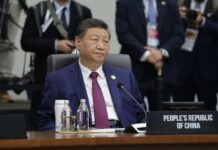
The ambiguity of the Trump-Xi meeting leaves U.S.-China trade relations shrouded in uncertainty, raising concerns over economic stability.
Story Snapshot
- Trump and Xi’s meeting concluded without clear public agreements, fueling market uncertainty.
- Trump announced the resumption of nuclear testing shortly before the meeting, overshadowing trade talks.
- The absence of immediate public statements suggests ongoing negotiations or strategic silence.
- The meeting’s brevity contrasted with its high stakes in global trade and geopolitics.
Ambiguity in U.S.-China Trade Talks
On October 30, 2025, President Trump and Chinese leader Xi Jinping met in South Korea for a highly anticipated bilateral discussion. Despite the meeting’s potential to reshape U.S.-China trade dynamics, it concluded after just 100 minutes, leaving the public and markets without clarity on any agreements reached. Trump’s earlier statements had suggested significant deals were forthcoming, but the lack of immediate announcements instead fueled speculation and concern over the future of bilateral relations.
The timing of Trump’s announcement to resume nuclear testing added another layer of complexity. Just hours before meeting Xi, Trump declared via Truth Social that the U.S. would restart nuclear weapons testing, citing China’s nuclear advancements. This development cast a shadow over the trade talks, raising questions about its impact on diplomatic negotiations and the broader geopolitical landscape.
Strategic Considerations and Global Impact
The meeting took place against the backdrop of the Asia-Pacific Economic Cooperation summit, with Trump simultaneously engaging in trade negotiations with other regional partners. His administration’s focus on securing rare earth minerals and diversifying supply chains away from Chinese dependence underscores the strategic considerations at play. Such moves aim to reduce U.S. vulnerability in critical technology sectors and counter China’s leverage over global supply chains.
Businesses and investors face continued uncertainty, with the absence of clear outcomes from the meeting affecting their ability to plan operations effectively. The lack of public clarity on tariff policies, export controls, and market access compounds these challenges, potentially stalling investment decisions and economic growth. The technology sector, in particular, awaits more concrete policy directions, given its reliance on rare earth minerals and advanced technologies.
Uncertain Path Forward in Trade Relations
The cordial tone adopted by both leaders, with Trump referring to Xi as a “friend” and Xi emphasizing partnership, suggests a diplomatic reset. However, the substantive issues—rare earth minerals, technology exports, agricultural access, and fentanyl flows—remain unresolved. This ongoing ambiguity highlights the complex power dynamics between the two nations, with both seeking leverage over critical economic and technological domains.
In the absence of immediate resolutions, the trajectory of U.S.-China trade relations remains uncertain. The potential for future negotiations or strategic silence leaves stakeholders on alert, anticipating further developments that could shape the global economic landscape for years to come.
🚨 "Xi was very cold, nothing real was discussed. POTUS wanted to strike a deal, but Chinese weren't interested" – APEC Sources.
All the hype ended in a disaster similar to Trump – Putin meet in Alaska. 😔pic.twitter.com/dfDrTA1VYi
— Arun Pudur (@arunpudur) October 30, 2025
The meeting’s outcome will significantly influence whether the U.S. can diversify its rare earth supplies and reduce dependency on China or if China continues to hold sway over essential global supply chains. The coming months will determine if this meeting represents a genuine breakthrough or merely a pause in a protracted trade conflict.
Sources:
Trump-Xi Meeting Wraps Up in Less Than Two Hours; Trade War Resolution Uncertain