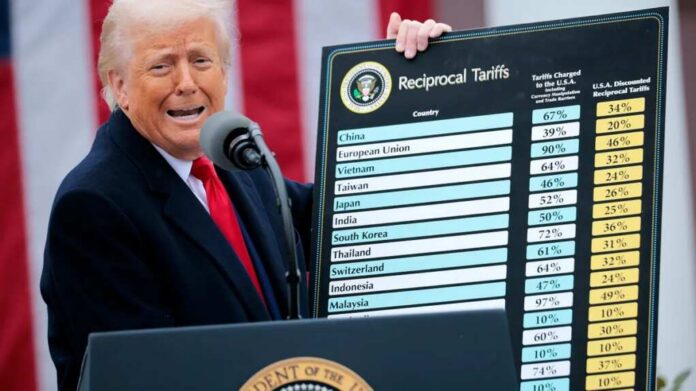
President Trump swiftly imposes 10% global tariffs under new legal authority, announcing a hike to 15% for some nations, defying Supreme Court setbacks to protect American workers from unfair trade.
Story Snapshot
- Trump shifts to Section 122 of the Trade Act after SCOTUS strikes down IEEPA tariffs, maintaining high rates to fix trade deficits.
- Tariffs start at 10% on February 24, 2026, with 15% increase announced, targeting payments imbalances while exempting USMCA goods and critical items.
- Effective rates hit 13.7% pre-substitution, highest since 1941, generating billions in revenue for fiscal strength.
- Time-limited to 150 days unless Congress extends, prioritizing economic nationalism over globalist free trade excesses.
Trump’s Legal Pivot Secures Tariff Continuity
President Donald J. Trump signed a proclamation under Section 122 of the Trade Act of 1974, imposing a temporary 10% tariff on global imports days after the Supreme Court invalidated prior IEEPA-based measures. The administration targets fundamental international payments problems driving massive U.S. trade deficits. This move ensures policy continuity, shielding American industries from cheap foreign dumping that hollowed out manufacturing under past globalist regimes. Exemptions cover critical minerals, pharmaceuticals, energy, and USMCA-compliant goods from Canada and Mexico. Implementation began February 24, 2026, with the tariff limited to 150 days unless extended by Congress.
Escalation to 15% Targets Worst Offenders
Trump announced an increase to 15% tariffs the day after the initial proclamation, focusing on nations like China with 33.4% effective rates by late 2025. This builds on 2025 escalations, including 50% Section 232 duties on steel and aluminum, and de minimis hikes on Chinese goods to 120% or $100 per item. Effective tariff rates reached 9.8% by December 2025, generating $189.4 billion in revenue—vital funds reclaimed from unfair trade practices that fueled inflation and job losses. Metals sectors now face 39.6% rates, rebalancing decades of exploitation by adversaries.
Economic Impacts Favor American Revival
Short-term effects include a 0.6% consumer price rise and 0.3 percentage point unemployment increase by end-2026, hitting metals, vehicles, and electronics hardest, with $30 billion revenue from the 150-day period. Long-term projections show 0.1% smaller GDP if extended, yet $1.3 trillion in conventional revenue over a decade offsets costs through behavioral shifts and domestic production boosts. Households face $800 annual losses if tariffs expire, underscoring the need for permanence to end reliance on foreign supply chains vulnerable to China. This strategy echoes successful first-term actions, prioritizing U.S. sovereignty.
Trading partners like China face export reductions, while U.S. importers pass costs to consumers in a regressive pattern, though fiscal gains strengthen national security against economic warfare.
US Tariff Rates To Hit 15% Or More For Some Nations Under New Strategy https://t.co/QpGiuMxbyB
— zerohedge (@zerohedge) February 27, 2026
Expert Views and Legal Outlook
Yale Budget Lab models the 13.7% pre-substitution rate as the highest since 1941, projecting GDP drags but $1.1 trillion dynamic revenue amid extension uncertainties. Wharton estimates 9.1% forward rates post-shift, viewing the 15% hike as a minor adjustment with behavioral offsets. PIIE anticipates Section 122 challenges in courts, potentially delaying resolutions over a year, similar to IEEPA’s fate. These tariffs counter Smoot-Hawley warnings by focusing on targeted rebalancing, not blanket protectionism, restoring fairness eroded by Biden-era overspending and open borders.
Sources:
Yale Budget Lab: State of Tariffs February 21, 2026
Wharton Budget Model: Effective Tariff Rates and Revenues Updated February 23, 2026
Trade Compliance Resource Hub: Trump 2.0 Tariff Tracker February 24, 2026
PIIE: How Will Trump’s New 15 Percent Tariff Fare in Court
White House: Fact Sheet President Donald J. Trump Imposes a Temporary Import Duty February 2026