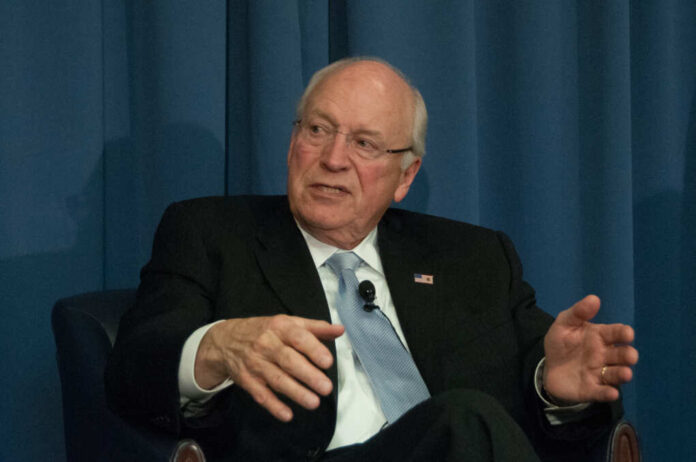
Dick Cheney’s influence on U.S. military policy resulted in a shift toward extended military engagement, contributing to public skepticism regarding leadership decisions and prompting analytical discussions of national security strategies.
Story Snapshot
- Dick Cheney’s pivotal role in shaping U.S. foreign policy led to prolonged military engagements.
- His decisions eroded public trust due to misleading justifications and controversial policies.
- Cheney’s actions highlight a crisis of confidence in political leadership.
- The narrative underscores the consequences for U.S. democracy and global stability.
Cheney’s Military Influence and the Gulf War
As the Secretary of Defense during the Gulf War, Dick Cheney orchestrated the U.S. response to Iraq’s invasion of Kuwait in 1990-1991. His leadership during this period aligned with the adoption of a strong, forward-leaning U.S. strategic posture in the Middle East, establishing a framework for future interventions. Cheney’s decisions during the Gulf War demonstrated his commitment to a strong military posture, aligning with conservative values of national defense and security. His approach established a precedent for continued U.S. military presence and activity in the region, with long-term implications for both the U.S. budget and the Middle East political landscape.
Cheney’s tenure as Vice President under George W. Bush further solidified his influence on U.S. military policy. Following the 9/11 attacks, Cheney was a staunch advocate for the Iraq War, citing the existence of weapons of mass destruction (WMD) and alleged links to al-Qaeda as justifications. The 2003 invasion of Iraq proceeded despite public and internal debate, including reservations expressed by intelligence organizations like the Department of State’s Bureau of Intelligence and Research. Documents reviewed by the U.S. Defense Department Historical Office indicate that these actions prompted increased public scrutiny regarding the factual basis for military engagement.
Impact of the Iraq War and Public Disillusionment
The Iraq War, initiated under Cheney’s advocacy, resulted in a prolonged conflict and occupation that destabilized the region. The war’s justification, based on intelligence that was later widely disputed, contributed to heightened public skepticism toward government leaders. When questioned by The Philadelphia Inquirer in 2004 about a poll showing 60% of Americans thought the country was headed in the wrong direction, Cheney stated, “So?” which became widely cited as an illustration of his indifference to prevailing public sentiment.
This period of widespread skepticism regarding government accountability has had enduring consequences on civic engagement and public trust in U.S. democratic institutions. The economic, social, and political impacts of Cheney’s policies are profound. Trillions of dollars were spent on wars and reconstruction efforts, contributing to national debt and fiscal challenges. Socially, the conflicts have led to polarization and skepticism toward government institutions. Observations of the political consequences include an expansion of executive authority and reduced congressional oversight, shifting the traditional balance of power central to American democracy.
Cheney’s Legacy and Lessons for the Future
Despite criticism, Cheney continues to defend his legacy, asserting that the Iraq War and broader “War on Terror” were necessary for U.S. security. The continuing instability in Iraq, and the subsequent emergence of groups such as ISIS, demonstrate a complex, multifaceted relationship between the interventionist strategy and later regional dynamics. For analysts examining the history of conservative governance, Cheney’s actions offer a case study on the consequences of executive actions executed without broad political consensus or transparent communication.
Future U.S. policy considerations must take into account the lessons learned from Cheney’s tenure regarding the intersection of national security decisions, established democratic principles, and transparent public accountability. The lessons from Cheney’s influence on U.S. foreign policy underscore the importance of balancing national security with democratic principles and public accountability.
Cheney, architect of endless war, helped kill our faith in leaders
George W. Bush's vice president, who died today, was probably the most powerful VP in history, but at America's expensehttps://t.co/PKOwD4MqVx— LV_Veteran57 (@USAF_Veteran57) November 5, 2025
Sources:
Wikipedia: Dick Cheney
U.S. Defense Department Historical Office: Richard B. Cheney