Even after Maduro’s capture, the Senate is warning that letting any president wage “law-enforcement” war overseas without Congress could hollow out the Constitution.
Quick Take
- Sen. Rand Paul publicly broke with President Trump’s Venezuela operation, calling the strikes “war” that required congressional authorization.
- The Trump administration has argued the Maduro action was a narco-terrorism law-enforcement mission, not a war requiring a vote.
- The Senate voted 52-47 to advance a War Powers Resolution (S.J.Res.90) aimed at blocking further unauthorized U.S. hostilities in Venezuela.
- Several Republicans backed limits while still supporting the capture of Nicolás Maduro, signaling discomfort with open-ended intervention.
Paul’s Warning: “Selling Drugs” Doesn’t Nullify War Powers
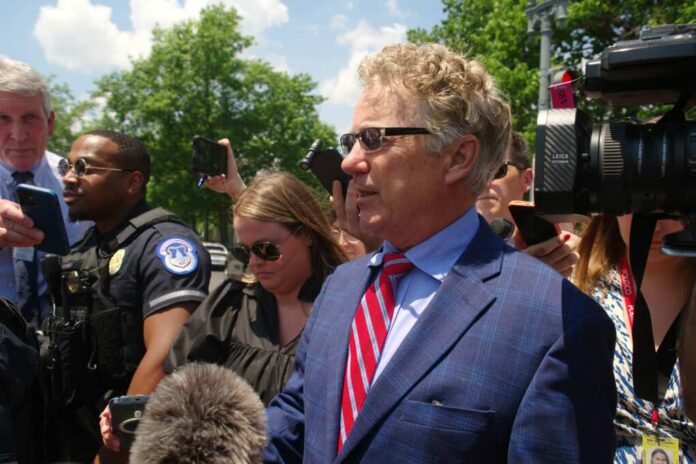
Sen. Rand Paul (R-Ky.) challenged the Trump administration’s framing of U.S. military strikes in Venezuela that captured Nicolás Maduro and his wife, Cilia Flores, who were taken into U.S. custody to face narco-terrorism charges. Paul said bombing and regime removal cannot be waved away as routine law enforcement simply because the target is accused of drug crimes. Paul’s core point was procedural: Congress, not the executive alone, must authorize hostilities.
Paul’s comments landed as the Senate prepared a direct test of the War Powers Act framework. He emphasized that the Constitution vests war-declaring authority in the legislative branch, while the president executes policy after authorization. The administration, meanwhile, has maintained the U.S. is “not at war” and has signaled it does not intend an occupation. That split—war versus law enforcement—now drives both the legal argument and the political dispute.
What the Senate Advanced, and Why It Matters
On Jan. 9, 2026, the Senate voted 52-47 to advance a War Powers Resolution targeting U.S. actions in Venezuela. The measure—S.J.Res.90—was described as a way to curb escalation and require explicit authorization for continued hostilities. The procedural posture matters because war powers resolutions receive special treatment in the Senate, limiting leadership’s ability to bottle them up. In practice, that means a determined bipartisan coalition can force debate even when the White House objects.
Support for advancing the resolution did not translate into sympathy for Maduro. Senators backing limits generally separated two questions: whether Maduro’s removal was good for U.S. interests and whether the method used set a precedent for unilateral war-making. That distinction is crucial for voters who want strong action against criminal regimes but do not want another blank-check conflict. The Senate’s move signaled that, at least for now, the constitutional process is not being treated as optional.
Republicans Split: Anti–Endless War vs. Party Loyalty
The vote exposed familiar fault lines inside the GOP coalition. Some Republicans aligned with Paul’s long-running non-interventionist instincts, arguing that even successful missions can produce dangerous precedents if Congress is cut out. Others supported the operation and questioned the timing of a resolution after a high-profile capture. Sen. Susan Collins backed the mission’s apparent precision but warned against long-term U.S. forces or the United States “running Venezuela,” reflecting concern about mission creep.
Sen. Josh Hawley echoed a position shared by many voters after two decades of Middle East entanglements: if America is going to commit blood and treasure, the public deserves an open debate and an on-the-record vote. Sen. Thom Tillis argued the vote timing was problematic, highlighting a political reality for the GOP: many Republicans want strength abroad, but they also want clear limits, a defined mission, and constitutional accountability for decisions that could widen into prolonged fighting.
The Constitutional Tension the White House Must Address
The administration’s stance rests on a key claim: that the Maduro operation is primarily a law-enforcement action against a narco-terrorism network rather than a war. Paul and allies rejected that as an end-run around the separation of powers, arguing that bombing a capital and forcibly removing a government looks like hostilities by any plain-language standard. Congress’s role is not a technicality; it is the mechanism the Founders designed to prevent unilateral, open-ended conflict launched by a single branch.
Supporters of the Senate action argue the goal is not to tie the president’s hands in a crisis, but to force clarity: what is the mission, what is the legal authority, what are the limits, and what ends the operation? Critics of war powers enforcement counter that modern threats move quickly and that presidents need flexibility. The immediate problem is that both can be true—rapid threats exist, but so does constitutional structure—and the Venezuela case is now a live test of whether Washington will respect both.
Sources:
Rand Paul breaks with Trump on Venezuela, calls action ‘war’ as Senate prepares constitutional showdown
War Powers Resolution Venezuela
Should Congress Reassert Its War Powers Over Venezuela?
S.J.Res.90 — 119th Congress (2025-2026)