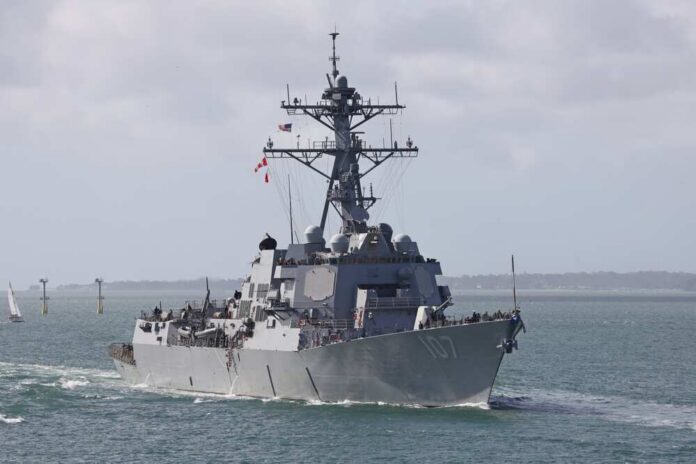
Two U.S. Navy destroyers defied Iranian threats and sailed through the mine-laden Strait of Hormuz, marking the first American warship transit since Tehran’s desperate attempt to choke off 20% of the world’s oil supply.
Story Snapshot
- USS Frank E. Peterson Jr. and USS Michael Murphy completed round-trip transit on April 11, 2026, launching mine-clearing operations
- President Trump announced Iran’s mine-laying fleet destroyed with 28 boats sunk, paving way for reopening critical oil chokepoint
- U.S. acted unilaterally without coordinating with Iran, demonstrating American resolve while peace talks continue in Pakistan
- Full clearance of haphazardly-placed Iranian mines could take until late summer 2026, delaying commercial tanker traffic
Navy Demonstrates Strength After Iran’s Reckless Mining Campaign
The USS Frank E. Peterson Jr. and USS Michael Murphy sailed from the Arabian Sea into the Persian Gulf and back on April 11, 2026, in a deliberate show of American naval power. U.S. Central Command announced the transit as the beginning of mine-clearing operations targeting Iranian mines scattered across the Strait of Hormuz. President Trump confirmed via Truth Social that the U.S. destroyed Iran’s mine-laying capabilities, claiming 28 Iranian boats now rest at the bottom of the strait. The transit occurred without Iranian coordination, underscoring American determination to secure freedom of navigation regardless of Tehran’s objections.
Critical Chokepoint Remains Hazardous Despite Initial Success
Iran began haphazardly laying mines across the 21-mile-wide strait starting February 28, 2026, when the U.S.-Israeli conflict with Iran escalated. U.S. officials report mines drifting unpredictably across the 200-square-mile Traffic Separation Scheme, creating ongoing dangers for deep-draft commercial tankers. The Navy’s capability to clear these mines has been compromised after four Avenger-class mine countermeasures ships were decommissioned from Bahrain in September 2025 and removed from the theater in January 2026. Current operations now rely on destroyers, underwater drones, Littoral Combat Ships, and MH-53E helicopters—a stark reminder of how bureaucratic decisions to retire specialized assets left America vulnerable when threats materialized.
Global Commerce Held Hostage While America Cleans Up Iranian Mess
The strait carries approximately 20% of global crude oil, making its closure an economic catastrophe for oil importers including China, Japan, South Korea, and European nations. Saudi Arabia and the United Arab Emirates have been unable to export tanker shipments while mines remain active. Naval experts estimate full clearance could take until late summer 2026, based on the 1991 Gulf War precedent when similar operations required 51 days with superior mine-clearing assets. President Trump framed the operation as America doing the world “a favor” by shouldering the burden other nations refuse to address, highlighting how U.S. taxpayers once again foot the bill for global security while allies sit on the sidelines.
American Resolve Contrasts With Allied Inaction
The transit reveals a troubling pattern where America acts decisively while supposed allies remain passive beneficiaries of U.S. military strength. Before the destroyers’ passage, American forces destroyed over 16 Iranian mine-laying boats, support vessels, and storage facilities including infrastructure on Qarg Island. CENTCOM promised to “share safe pathway soon” for commercial vessels, yet the burden of establishing that pathway falls entirely on American sailors and resources. This operation exposes the fundamental question frustrating Americans across the political spectrum: why does the United States perpetually sacrifice blood and treasure to protect global commerce that enriches other nations, while those same nations criticize American foreign policy and contribute virtually nothing to maintaining international shipping lanes?
U.S. Navy Destroyers Lead New Mine-Clearing Charge in Strait of Hormuzhttps://t.co/2Tplyvk398
— RedState (@RedState) April 11, 2026
The April 11 transit demonstrates warship navigability but leaves the dangerous work of clearing hundreds of mines unfinished. Peace talks in Pakistan proceed alongside these military operations, creating an awkward dynamic where America pursues de-escalation while simultaneously asserting unilateral control over strategic waterways. Whether full clearance arrives on schedule remains uncertain, as the haphazard Iranian mine-laying and limited U.S. countermeasure assets complicate timelines. What is certain: American sailors once again risk their lives to clean up a mess created by a regime that faces minimal consequences for its reckless actions, while the world’s maritime commerce depends entirely on U.S. willingness to maintain order at sea.
Sources:
US warships transit Strait of Hormuz in mine clearance op – The New Arab
U.S. Navy Hormuz Transit – House of Saud
U.S. Navy destroyers transit Strait of Hormuz – Defence Blog
US warships pass Hormuz amid mine clearing ops – Economic Times