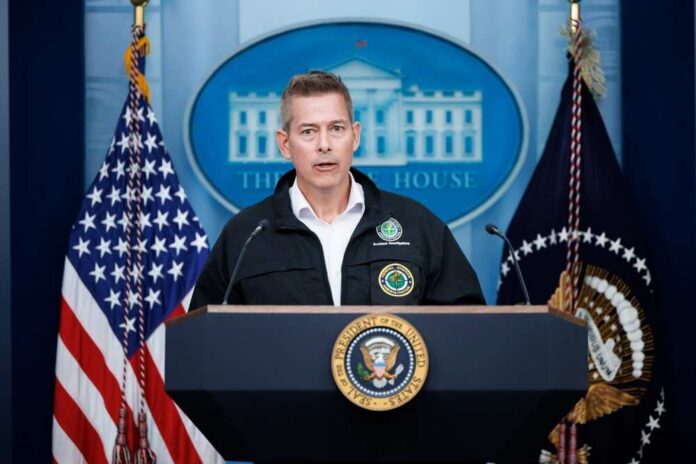
America’s skies were pushed toward “mass chaos” because Washington let critical air-traffic staffing hinge on a shutdown paycheck clock.
Story Snapshot
- Transportation Secretary Sean Duffy warned that if the 2025 shutdown dragged on, DOT could be forced to close parts of U.S. airspace due to controller shortages.
- Flight delays spiked as unpaid air traffic controllers faced fatigue and financial strain, triggering safety-related slowdowns at major hubs.
- Duffy and FAA Administrator Bryan Bedford announced targeted flight-reduction plans, then froze reductions at 6% after staffing improved and President Trump assured back pay.
- The FAA emphasized safety-first pacing—slowing traffic rather than risking understaffed operations—while holiday travel demand loomed.
Duffy’s Airspace Warning: When “Essential” Workers Are Treated as Optional
Transportation Secretary Sean Duffy delivered a blunt message if the partial government shutdown continued into the next week, the U.S. could be forced to close “certain parts” of its airspace. The reason was not weather, terrorism, or a technical failure, but staffing—air traffic controllers working without pay as the shutdown stretched to 35 days, with absences rising and fatigue mounting.
Flight data underscored how quickly a shutdown can hit ordinary Americans where it hurts: missed connections, canceled plans, and hours-long delays. More than 10,000 delayed U.S. flights over one weekend, followed by roughly 4,700 more delays on Monday. Duffy later said nearly half of delays in one period were tied to staffing problems—far above the typical baseline—showing the disruption wasn’t theoretical.
How “Staffing Triggers” Slow the System to Protect Safety
The FAA’s response relied on what officials and reporting described as “staffing triggers,” protocols that reduce the number of aircraft moving through constrained airspace when staffing falls below safe thresholds. Those measures can ripple nationwide because the U.S. network runs on connected hubs; when Newark, LaGuardia, or Chicago O’Hare backs up, small and mid-sized airports feel it too as incoming aircraft and crews fall out of position.
Chicago O’Hare became a focal point when multiple staffing triggers were reported over a weekend, driving ground-delay programs and compounding traveler frustration. The core issue was not a lack of demand—Thanksgiving travel was approaching—but a lack of predictable manpower. NATCA, the controllers’ union, highlighted the strain on families forced to cover basics while continuing to work a safety-critical job under intense cognitive load.
Emergency Flight Reductions—and Why They Were Froze at 6%
As pressure rose, Duffy and FAA Administrator Bryan Bedford outlined a phased plan to reduce airline traffic at dozens of high-impact locations. The strategy aimed to prevent uncontrolled gridlock by cutting volume in a measured way, with officials also describing restrictions that could touch general aviation and certain flight rules categories. The point was operational realism: fewer controllers on the boards means fewer aircraft can move safely, regardless of schedules.
Few months ago, Duffy and Bedford announced a freeze holding reductions at 6% rather than escalating toward 10%, citing a staffing surge and President Trump’s assurance that controllers would receive back pay. Officials said data would guide when and how operations could normalize. The administration also stressed that international flights were not being targeted, keeping the focus on domestic choke points where cascading delays were most likely.
What This Episode Reveals About Shutdown Politics and Everyday Americans
There’s a stark chain of cause and effect: a funding lapse became the longest shutdown on record at the time, essential workers stayed on the job without pay, staffing reliability eroded, and the flying public absorbed the consequences. Duffy publicly blamed Democrats for prolonging the standoff, while industry voices urged Congress to act to protect holiday travel. One conclusion: safety constraints were driving the decisions.
Transportation Secretary Sean Duffy on Partial Government Shutdown Affecting Airport Travel (VIDEO) https://t.co/5GdvuUmpkb #gatewaypundit via @gatewaypundit
— Thomas Register (@Gregister) March 16, 2026
For travelers, the lesson is simple and frustrating: when Washington games out leverage through shutdowns, the penalties often land on families trying to get home and on workers tasked with keeping the country functioning. The FAA’s slowdown approach reflects a constitutional reality conservatives tend to recognize—government has core duties, and transportation safety is one of them. The open question left is how quickly normal staffing can be stabilized when pay becomes political.
Sources:
U.S. may be forced to close some airspace next week if government shutdown continues
Transportation Secretary Sean Duffy warns of ‘mass chaos’ in skies if shutdown continues
US Transportation Secretary Sean P. Duffy, FAA Administrator Bryan Bedford Freeze
US Transportation Secretary Sean P. Duffy, FAA Administrator Bryan Bedford Outline